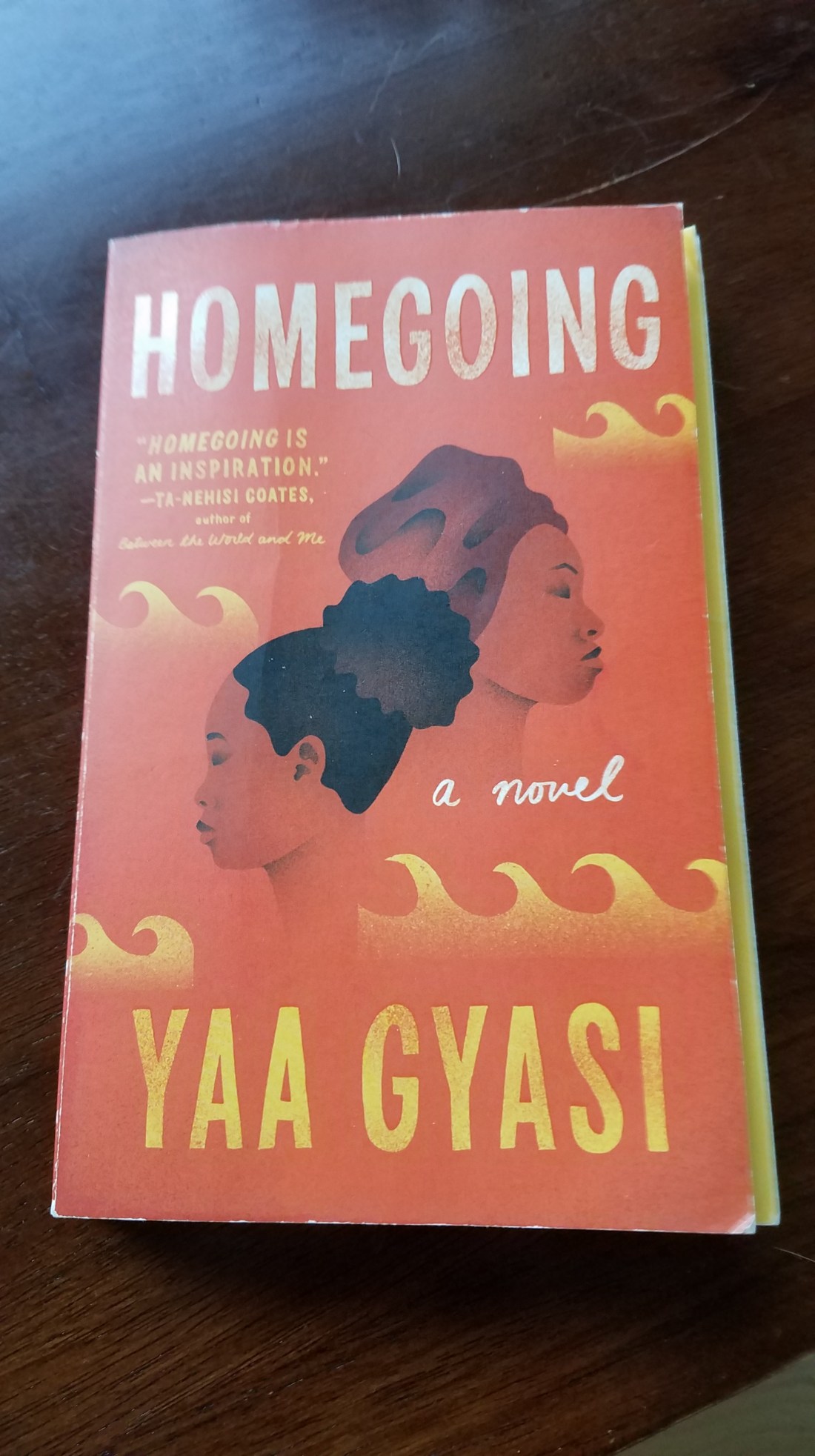
Black History Month Book Report #1: Homegoing, by Yaa Gyasi

First off, this is a great book that succeeds on just about every level. If good books is your jam, here is one.

A woman escapes slavery in the Gold Coast in the late 18th Century. She leaves behind one daughter, goes inland to freedom, has another. One daughter marries an Englishman, and lives out her life in a castle by the ocean. The other is captured, and taken there as a slave, to be sold on to the American South. The novel follows their children and grandchildren down the generations, alternating between the lines, as they live their lives embedded in our history, both African and American, until more or less the present day.

It’s a worthy conceit to hang the novel’s structure on, though not without its dangers. Characters rarely appear in more than two or three successive chapters, and each chapter has a new protagonist moving through a significant chunk of their lives. Each has their arc, though thanks to the history we’re following, arcs do not so much as close as find a way to keep going under immense and unfair restrictions. In less deft hands, a novel like this might fail to resonate, but Gyasi does such a good job with her characters that most all of the chapters are satisfying, to the reader if not the protagonist, and when characters reappear in their children’s lives we can see what those children can’t, that their parents were people in their own right, trapped in unkind history, and doing what best they could under the circumstances, even if that best wasn’t great.

Gyasi’s gorgeous, evocative prose helps the project along immensely. She has a knack for framing that conveys a rich, deep world in the background, the kind of world you could wander off and get lost in if you weren’t careful. But you never do, because the narrative carries you forward, through decades and centuries of lived history, of heartbreak and small victories just great enough to keep it all going, all of it rendered with flawless grace and economy.

My intent is to keep things spoiler-free, so I won’t go into individual characters and arcs. Telling truth, I think it best to encounter them with fresh eyes, even if you know your history well. What Homegoing excels at is melding that history with story, with the stories of lives lived swimming in history’s currents in the wake of the African slave trade. It is, all of it, complicated, with sympathetic villains and humanizing moments to spare, and Gyasi doesn’t spare the reader that complexity in the service of easy answers. This is a work of art, not polemic, after all.

I’m disinclined toward numerical rating, or trying to give my subjective experience a gloss of objectivity. Suffice to say, if you are a person who enjoys moving, beautifully written, well-constructed literature (with or without a capital ‘L’), you will find Homegoing to be all that and more. If you have the interest (and fortitude) to take a long and often painful look at the ramifications of human chattel slavery, in a well-researched  and -rendered (albeit fictional) form, you could do a lot worse than read Homegoing.

It’s one thing to know something intellectually, say that Jim Crow laws in the post-Civil War South led to all manner of abuses. It’s another to engage with a firsthand account, or a first-rate artistic engagement, one that plays to the full human spectrum, rather than seek emotionless shelter in facts. To my mind, it’s one of the highest purposes of human creative endeavor, an accomplishment of serious magnitude when well-executed. Yaa Gyasi has done that, and then some, with Homegoing.

You should read it.

9/11/18

I was gonna write a whole thing about 9/11, but my memories are no specialer than anyone else’s – and less special by far than many. Besides, look around. We haven’t learned a goddam thing. Bin Laden succeeded beyond his wildest dreams.

So, instead, here is a sentence that is also a haiku:

Kids born after the
towers fell can now fight the
war we’re not losing.

An Open Letter to David Meinert

We all want to think of ourselves as good people. Even when we are imperfect, and have done wrong, and been ‘pushy’ or ‘handsy’ with women. Or we used to drink too much, and maybe some of our memories of the way things went down differ from the other people involved. And, you know, times are changing. Even two or three years ago, before #metoo really picked up momentum, things were different between men and women. Never mind how things were back at the millenium’s turn, or, god help us all, the ’80s and ’90s, when rape culture was, well, culture.

But here we are.

Now, before I go any further, I want you to know that I believe you when you say #metoo has opened your eyes, and that you’re trying to do better, trying to make changes internally while also making noise to help make changes in the external world. I think it’s good you’re engaging, and I hope you find a good way to continue.

But I also believe the women in this KUOW article. And I think you should, too.

I know your memories don’t jibe. And some of them have stayed ‘friends’ with you since. Which must seem weird to you, since I’m sure if someone did to you what you did to them, you probably wouldn’t have anything to do with that person ever again. I’m also betting no one ever has done something like that to you. So maybe you wouldn’t do what you think you would do. I didn’t. But, you know, it’s not really that weird you might misremember or have forgotten something, considering the way alcohol flows through most of these stories, and how tricky memory is even when everything’s working the way it should. And staying friendly (or even actual, like, friends) with people who’ve assaulted you or even just been really shady about sex stuff is something women have been doing for, like, ever. Especially when it involves someone with your footprint. Even if it’s just going along to get along instead of, say, abject fear you might use your significant influence and power to quash them. For my own part, when I first starting coming to terms with this gender relations sea change we’re in, I wrote this confession (Serious Trigger Warning for Survivors of Sexual Assault). About a year after, a friend from college — a close friend, who I hooked up with once — asked if she was one of the people I was writing about. To my deep shame and chagrin, she was not. And we actually were (and, I believe, still are) friends.

But that’s not the real reason I think you should take these five women at their word, whatever your memories, or the stories you’ve told yourself about yourself, or them. Continue reading “An Open Letter to David Meinert”

The Closest I Ever Came to Being Sexually Assaulted

It was the summer of 1992. I was nineteen years old, and had finished my first year of college. I was living near Ann Arbor, Michigan, staying with a friend and his family for the summer between school years.

Ann Arbor is a college town, so even in summer there was stuff to do. But we were under twenty-one, and broke (I had the worst job I ever had, that summer, or close to it, working for a moving company that required I wake up and call in at 7am to see if they had work for me that day; most days, they didn’t). But my friend was really into dancing — I liked it, too — so we would, once every week or two, splurge and pay the cover at a dance club in town. I want to say it was called Tangerine, or something like that.

The place was alright, as small-town dance clubs go. Not that I was particularly an aficionado. But I liked dancing, and I liked the at least notional chance of meeting women, so I was happy enough to go those nights we could scrape together the five bucks each the place cost.

Then, one night, I had to take a shit.

I didn’t want to do it there. The bathrooms were not the most sanitary and, worse, the stall doors had no locks. But as time passed and the pressure mounted, what I did and didn’t want mattered less and less. I couldn’t even leave the club to go find a more suitable spot, because I’d have had to pay cover again, and I had no money for that.

So I did what I had to do. What was the worst thing that could happen? Continue reading “The Closest I Ever Came to Being Sexually Assaulted”