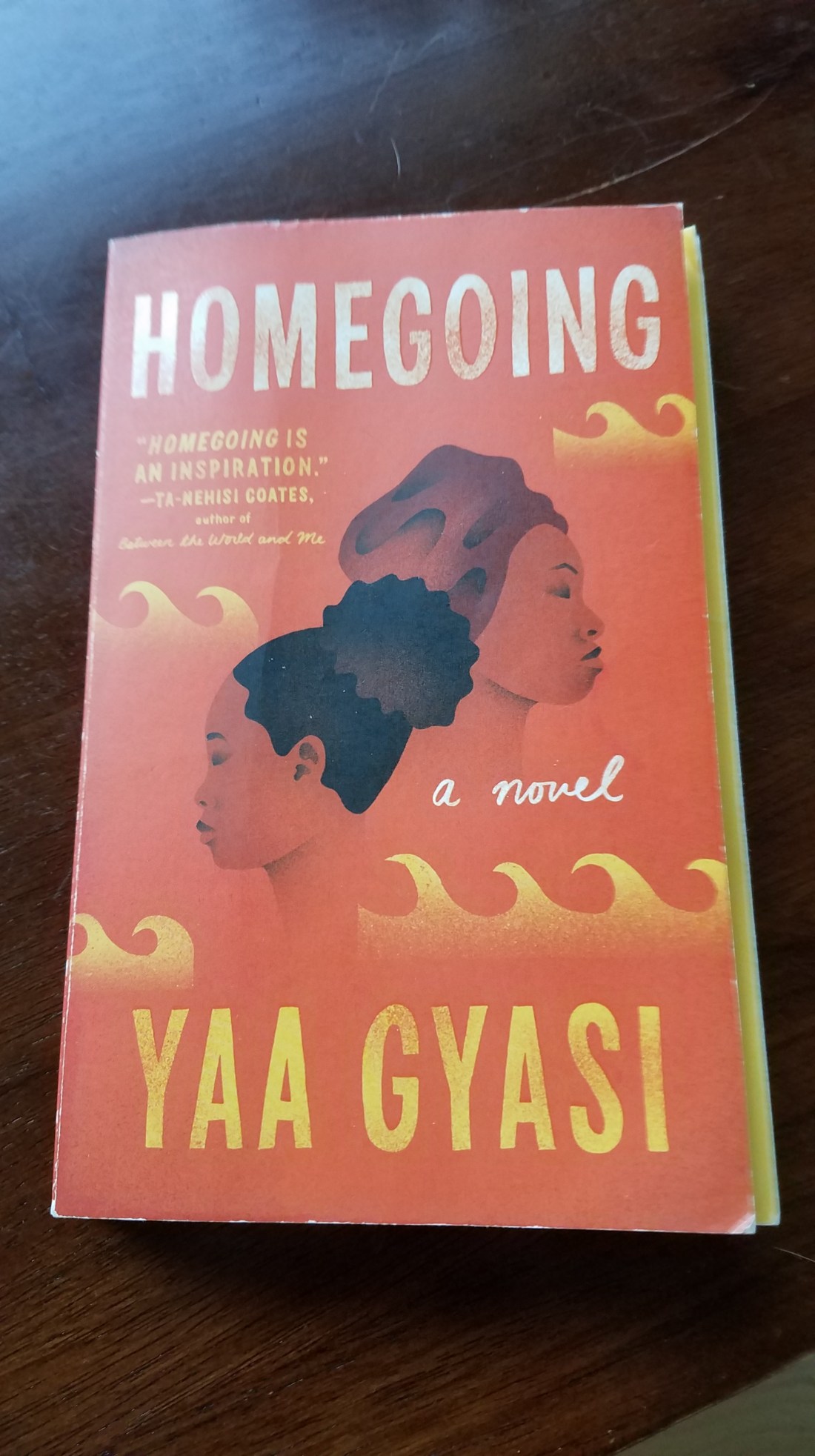
Black History Month Book Report #1: Homegoing, by Yaa Gyasi

First off, this is a great book that succeeds on just about every level. If good books is your jam, here is one.

A woman escapes slavery in the Gold Coast in the late 18th Century. She leaves behind one daughter, goes inland to freedom, has another. One daughter marries an Englishman, and lives out her life in a castle by the ocean. The other is captured, and taken there as a slave, to be sold on to the American South. The novel follows their children and grandchildren down the generations, alternating between the lines, as they live their lives embedded in our history, both African and American, until more or less the present day.

It’s a worthy conceit to hang the novel’s structure on, though not without its dangers. Characters rarely appear in more than two or three successive chapters, and each chapter has a new protagonist moving through a significant chunk of their lives. Each has their arc, though thanks to the history we’re following, arcs do not so much as close as find a way to keep going under immense and unfair restrictions. In less deft hands, a novel like this might fail to resonate, but Gyasi does such a good job with her characters that most all of the chapters are satisfying, to the reader if not the protagonist, and when characters reappear in their children’s lives we can see what those children can’t, that their parents were people in their own right, trapped in unkind history, and doing what best they could under the circumstances, even if that best wasn’t great.

Gyasi’s gorgeous, evocative prose helps the project along immensely. She has a knack for framing that conveys a rich, deep world in the background, the kind of world you could wander off and get lost in if you weren’t careful. But you never do, because the narrative carries you forward, through decades and centuries of lived history, of heartbreak and small victories just great enough to keep it all going, all of it rendered with flawless grace and economy.

My intent is to keep things spoiler-free, so I won’t go into individual characters and arcs. Telling truth, I think it best to encounter them with fresh eyes, even if you know your history well. What Homegoing excels at is melding that history with story, with the stories of lives lived swimming in history’s currents in the wake of the African slave trade. It is, all of it, complicated, with sympathetic villains and humanizing moments to spare, and Gyasi doesn’t spare the reader that complexity in the service of easy answers. This is a work of art, not polemic, after all.

I’m disinclined toward numerical rating, or trying to give my subjective experience a gloss of objectivity. Suffice to say, if you are a person who enjoys moving, beautifully written, well-constructed literature (with or without a capital ‘L’), you will find Homegoing to be all that and more. If you have the interest (and fortitude) to take a long and often painful look at the ramifications of human chattel slavery, in a well-researched  and -rendered (albeit fictional) form, you could do a lot worse than read Homegoing.

It’s one thing to know something intellectually, say that Jim Crow laws in the post-Civil War South led to all manner of abuses. It’s another to engage with a firsthand account, or a first-rate artistic engagement, one that plays to the full human spectrum, rather than seek emotionless shelter in facts. To my mind, it’s one of the highest purposes of human creative endeavor, an accomplishment of serious magnitude when well-executed. Yaa Gyasi has done that, and then some, with Homegoing.

You should read it.

A Quick Note on My Political Praxis, That Others May Find Useful

There are candidates and politicians I like better. There are candidates and politicians I like worse. None are perfect, because all are fallible human beings who willfully and routinely put themselves in a position to make morally gray choices, often if not always among options of which none are what a regular person might call good. And though I do believe character matters, ultimately, my fealty is *not* to individual candidates or politicians.

My fealty is to a platform of policies. Policies which in turn reflect my ideals.

Save the environment. Take care of everybody. Leverage the potential and talents of the entire human population. Minimize unnecessary suffering, maximize general prosperity and happiness. Make room for everyone to participate, thrive, and matter.

You know, bend the moral arc of history toward justice. Save the world. Eat the rich.

Just kidding on that last one. Mostly.

Anyhow, when I approach a political question – like how to vote, which party or candidate to support, where to donate whatever time and money I have to spare – I ask myself a simple question:

Which of the choices realistically brings me closer to the world I want to help bring about? Even if it’s not that close. Even if it’s a lesser-of-two-evils situation. Put it in the grand context, sink it into my lived historical particularity. Which choice moves us closer to the future progressives and liberals and, well, anyone left of wingnut these days want.

Because let’s be real: the stakes are as high as can be. Half the population on the verge of losing their bodily autonomy. Majority rule, hell, rule for the benefit of any but the richest and worst among us, threatened, along with the tattered remains of our democratic traditions. The planet we all live on heating up, soon to be past the tipping point and shit getting all kinds of fucked up. We need to be making big strides. Barring that, baby steps. Anything to start the momentum moving the right direction.

And we need to be pragmatic about it. Because our ideals – and the stakes – deserve no less.

9/11/18

I was gonna write a whole thing about 9/11, but my memories are no specialer than anyone else’s – and less special by far than many. Besides, look around. We haven’t learned a goddam thing. Bin Laden succeeded beyond his wildest dreams.

So, instead, here is a sentence that is also a haiku:

Kids born after the
towers fell can now fight the
war we’re not losing.

Impeaching Donald Trump

Oh, man, would I love to see that happen. I mean, set aside my deep, abiding, decades-long dislike for Donald Trump, who not only represents but literally embodies the absolute worst in both human nature and late-capitalist rape-culture patriarchy. The man is just absolutely terrible at the job. I mean, after Abu Ghraib and torture and our pre-emptive invasion of a sovereign nation that – however awful a regime Saddam Hussein’s Iraq was, and it was awful – had not attacked and was not going to attack us; after dropping the ball on terrorism and the cleanup after Hurricane Katrina; after firing so many US attorneys for not prosecuting Democrats and trying to privatize Social Security and all the other terrible things George W. Bush did in office, I didn’t think we could ever have such a terrible President again. But I was wrong. Oh, how I was wrong.

I’ll spare you the litany of his crimes and incompetence. You’re either well enough aware I’d just be re-traumatizing you, or you’re hate-reading this and won’t believe any of it. Suffice to say, when they told me when I was growing up that anyone could be President, I should have realized it was as much warning as patriotic bromide, and been more diligent in my citizenship.

But we are where we are, and with the midterms coming up, it’s more important than ever to get out and vote, and to flip one or both houses of Congress so as to provide the checks and balances that are supposed to be the main feature of the world’s greatest democracy.

And let’s be real. Even if we flip both House and Senate, and fill them with Democrats, it’s going to be tough as shit to get anything done, because veto-proof majorities aren’t likely to happen. Hell, flipping the Senate isn’t likely to happen (though it’s probably likelier than it would be without Donald Trump in the White House). But even just flipping the House gets us an institutional brake put on the tax cuts and over-deregulation that is the GOP’s stock in trade.

And the investigations, oh the investigations. Into Russia’s Cyberwar on us, in 2016 and beyond. Into the Trump family’s shady financial and business history. Into – if we push hard enough – all the backroom dealing and chicanery that drives our policy choices. That alone would make it all worth it.

But impeachment? It’s a red herring.

I mean, sure, it would be gratifying. It would even be justified (hello emoluments, hello self-dealing, hello unregistered foreign agents). But in the end it would be a hollow victory. Without 67 Senators willing to vote a conviction on all those high crimes and misdemeanors, it’s no more meaningful than when the Republicans did it to Bill Clinton in the ’90s. A symbolic gesture. A feel-good moment, which accomplishes very little.

And even if we did succeed in removing him from office, what does it get us but President Mike Pence? Who, while decidedly not smart, and a real jerkwad, is at least politically savvy enough not to keep destroying the GOP and the conservative brand. I mean, unless those aforementioned investigations turn up something so horrible that we take Robert Reich’s suggestion – as unlikely as it is appealing – to annul the results of the 2016 Presidential election, I think we’re better off with Donald Trump right where he is, making noise, accomplishing nothing, and shrinking the Republican party down to the hardest of hardcore white supremacists, Christian Dominionists, and oligarch/kleptocrats. Besides, if we get rid of Trump, that open up the field for a smarter, slicker, more eloquent fascist to run, one who won’t have his handicaps or record of failure.

No, painful as it will be, I think we’re best off with Trump as a lame duck keeping the seat warm til January 2021.

And once we’ve voted him out? Well, I for one can’t wait to see his ass perp-wallked to the federal pen, where he can spend what little is left of his life regretting the choices that led him there, and we can get down to fixing all the things he’s broken, and some other things, too.

John McCain’s Death

So… John McCain. Were there things to like about him? Sure. Did he have some good moments? Undoubtedly. There’s the one everyone’s sharing, where he told an old woman to her face that Barack Obama was a decent person and not a foreign-born Muslim spy/interloper/Manchurian candidate. Which, if you think about it, should not have been a high bar to clear. But given the turn toward wackadoodlism the GOP had taken and continues to take, I suppose that counts as political courage. Even if his thrusting of the unvetted, wholly unqualified half-term governor of Alaska into the national spotlight took that emergent wackadoodlism the rest of the way to cloudcuckooland, leading, among other things, to the cyberwar being waged on us by the Russians (remember Jade Helm? How Texans convinced themselves it was actually the US military invading them, to put them in concentration camps built from old Wal-Marts? And Greg Abbott sent the Texas state guard to ‘monitor’ the situation? That’s when the Russians knew they could cause us serious damage without firing a shot, just by feeding the credulous disinformation that fit their confirmation bias).

Of course, he never did meet a war he didn’t like (‘Bomb bomb bomb, bomb bomb Iran’). Or a tax cut he wouldn’t vote for. Truth be told, he was as reliable a conservative as anyone.

And, let’s not forget that, when the chips were down and the soul of America was on the line in the torture debate, the man who knew how not only evil but ineffective it was folded in the face of political headwinds. The man with the most moral authority on the subject – a man who might have saved us going down that slippery slope – opted to sponsor a toothless bill that exempted the CIA (hello, Gina Haspel, current director) from sticking to the Army Field Guide’s non-torturous techniques for interrogation. Which made the whole thing a distraction at best.

That he remained as popular as he did – and does, even among those who disagree with him – and that he still garners the respect that he does is a testament to John McCain’s real legacy, his greatest accomplishment by far, in which he was, I think, unparalleled: the man knew how to build, and maintain, a brand.

I mean, seriously. He was a torture survivor who signed off on officially-sanctioned torture, who voted with hardline conservatives ninety percent of the time, a man who lent his credibility to Sarah Palin and cleared the ground for the rise of Tea Party conservatism and the worst instincts of the American right. But we still call him a straight-talking maverick who always stuck by his principles and his sense of right and wrong.

Say what you will about the man. But that’s one hell of an accomplishment. Too bad it didn’t do anyone but him any good.