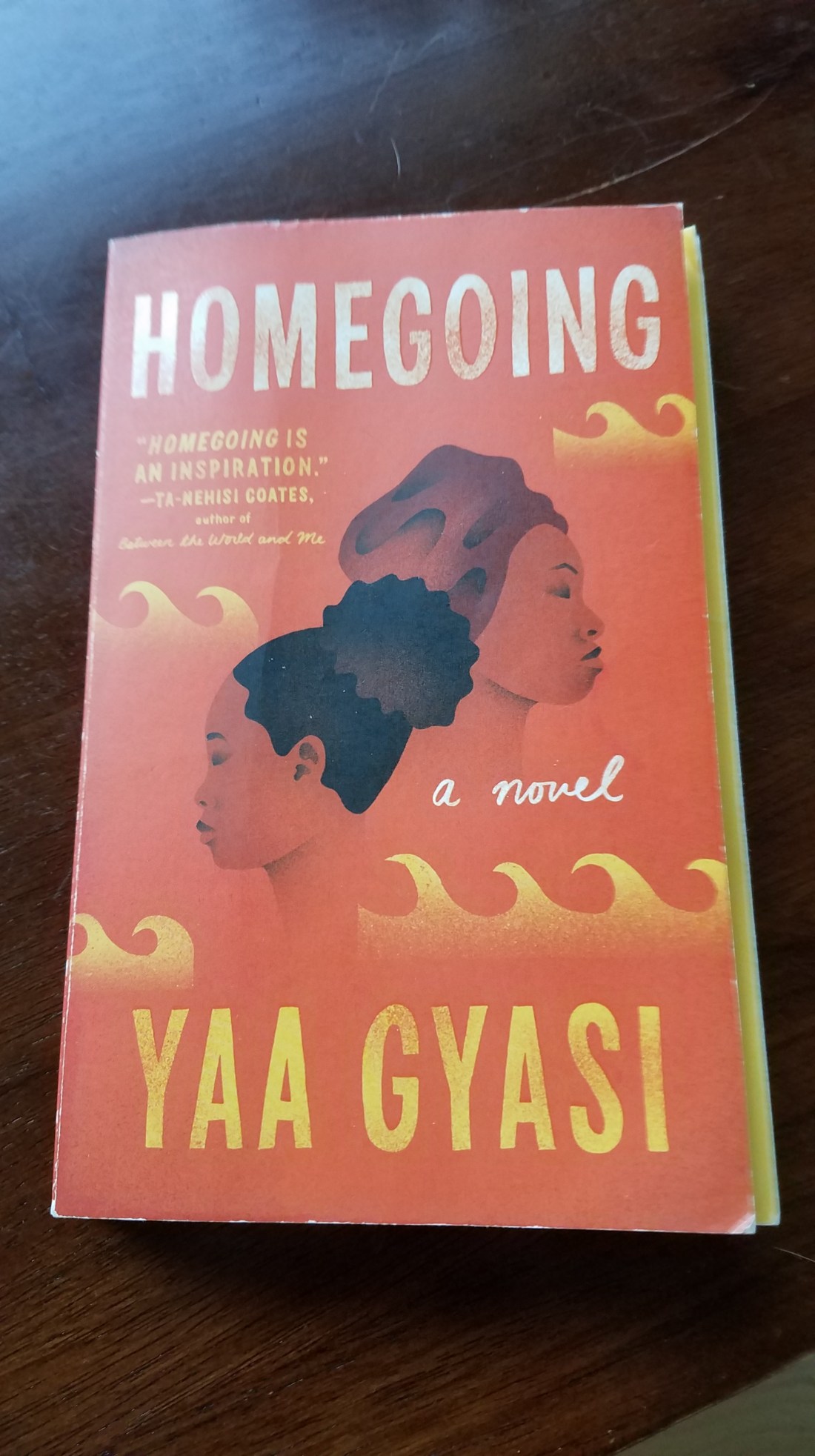
Black History Month Book Report #1: Homegoing, by Yaa Gyasi

First off, this is a great book that succeeds on just about every level. If good books is your jam, here is one.

A woman escapes slavery in the Gold Coast in the late 18th Century. She leaves behind one daughter, goes inland to freedom, has another. One daughter marries an Englishman, and lives out her life in a castle by the ocean. The other is captured, and taken there as a slave, to be sold on to the American South. The novel follows their children and grandchildren down the generations, alternating between the lines, as they live their lives embedded in our history, both African and American, until more or less the present day.

It’s a worthy conceit to hang the novel’s structure on, though not without its dangers. Characters rarely appear in more than two or three successive chapters, and each chapter has a new protagonist moving through a significant chunk of their lives. Each has their arc, though thanks to the history we’re following, arcs do not so much as close as find a way to keep going under immense and unfair restrictions. In less deft hands, a novel like this might fail to resonate, but Gyasi does such a good job with her characters that most all of the chapters are satisfying, to the reader if not the protagonist, and when characters reappear in their children’s lives we can see what those children can’t, that their parents were people in their own right, trapped in unkind history, and doing what best they could under the circumstances, even if that best wasn’t great.

Gyasi’s gorgeous, evocative prose helps the project along immensely. She has a knack for framing that conveys a rich, deep world in the background, the kind of world you could wander off and get lost in if you weren’t careful. But you never do, because the narrative carries you forward, through decades and centuries of lived history, of heartbreak and small victories just great enough to keep it all going, all of it rendered with flawless grace and economy.

My intent is to keep things spoiler-free, so I won’t go into individual characters and arcs. Telling truth, I think it best to encounter them with fresh eyes, even if you know your history well. What Homegoing excels at is melding that history with story, with the stories of lives lived swimming in history’s currents in the wake of the African slave trade. It is, all of it, complicated, with sympathetic villains and humanizing moments to spare, and Gyasi doesn’t spare the reader that complexity in the service of easy answers. This is a work of art, not polemic, after all.

I’m disinclined toward numerical rating, or trying to give my subjective experience a gloss of objectivity. Suffice to say, if you are a person who enjoys moving, beautifully written, well-constructed literature (with or without a capital ‘L’), you will find Homegoing to be all that and more. If you have the interest (and fortitude) to take a long and often painful look at the ramifications of human chattel slavery, in a well-researched  and -rendered (albeit fictional) form, you could do a lot worse than read Homegoing.

It’s one thing to know something intellectually, say that Jim Crow laws in the post-Civil War South led to all manner of abuses. It’s another to engage with a firsthand account, or a first-rate artistic engagement, one that plays to the full human spectrum, rather than seek emotionless shelter in facts. To my mind, it’s one of the highest purposes of human creative endeavor, an accomplishment of serious magnitude when well-executed. Yaa Gyasi has done that, and then some, with Homegoing.

You should read it.

I Know Why Nero Fiddled

I also know that that probably didn’t happen. But whatever its authenticity, the image of the emperor playing the fiddle while Rome burned endures. In common usage, it means ‘to occupy oneself with unimportant matters and neglect priorities during a crisis.’ Like rearranging the deck chairs on the Titanic.

But it’s not rearranging the deck chairs on the Titanic. It’s more like the band playing on as the ship upended and sank. It’s making art in the face of ongoing or oncoming catastrophe.

Half the people I know have some kind of creative pursuit as a way of making meaning in their lives. From what social media tells me, most of them are having problems working. It makes sense. Why bother making things when the whole world is going to shit? Is that really the best use of your time? What even is the best use of your time? Which fire should you be helping to put out? Or should you lay stores in and plan for the aftermath, look out for you and yours?

I don’t know the answers to those questions. Telling truth I have the opposite problem. I get up everyday and work on my novel, however I’m feeling, whether I want to or not. I can’t even imagine stopping, even though I think there’s a solid and growing chance that it’s pointless, at least in terms of getting it published and out into the reading world. Who even reads anymore, right? Who has time, what with Rome burning all around us?

There’s people who say making art’s more important than ever, times like these. Whether you’re offering distraction or insight or just putting our anxious and angst-ridden zeitgeist to words or images or music, what matters is the human spirit striving to make beauty and sense from a world sorely lacking in both.

That may be. But it’s not why I show up to work in the morning. I do it because it feeds me. Because it gives my life meaning and shape. Because I’ve known my whole life this is what I was meant for, whether I chose it or it chose me.

Because without it, I don’t know how I’d go on.

Wanna Read My Novel?

Is it finished? No. Well, the first draft is. Which is great as far as that goes, but let’s face it: it’s not worth a serious reader’s time and attention in its present form. And that’s okay, because now I’ve got to the end, I have a much better idea how make it so it is. I’m currently outlining the second draft, and I anticipate having it done around the end of summer.

So what’s the story about, you ask? Here’s a stab I made at some back-cover teaser copy:

Once upon a time, magic powered a civilization so advanced they made their gods themselves manifest. Then came the Wars of Avaree, which destroyed all they’d built. Centuries later, magic is the province of the powerful, looked on with suspicion and distrust by common folk.

Brenaea is a young woman with a quick mind and a talent for magic. When her father catches her practicing it, he casts her out, leaving her to wander the forest of the Greenswath with only her dog, Lively, for company. When she learns of the Celestere Academy, a school of magic rumored to accept women as students, Brenaea resolves to journey there, leaving behind everything she’s ever known.

The road is long, but the dangers Brenaea faces along the way pale in comparison to those she’ll face once she arrives. The Celestere Academy lies at the heart of a fragile political balance, one Brenaea threatens to upset. It will take all of Brenaea’s skill and determination to navigate its intrigues, along with help from a brilliant highborn student named Kian and a foul-mouthed tavern-keep named Marinie. The only question is whether she’ll be in more danger if she fails, or if she succeeds.


The novel’s working title is Neither Threat Nor Prey. It’s book one of a three-to-four book fantasy series chronicling Brenaea’s unlikely rise to power and prominence during a time of personal and political upheaval, which will change the course of history. It’s got magic, adventure, romance, intrigue. The whole project started life as a short story about two and a half years ago, but the characters weren’t satisfied with that, and the world just kept getting bigger and the story longer and I’ve just been running with it, trying to keep up. Continue reading “Wanna Read My Novel?”

Things I Learned on the Internet This Week 8/8/14

Another week gone, and the internet (and the world it reflects, or possibly refracts) continues to fascinate. So, in my continuing efforts to excuse to myself the embarrassing amount of time I spend surfing the internet, here is a selection of highlights from my procrastinations this week:

Warren Layre, 61, told The Inquirer in an interview last year that the officers beat him with a steel bar and kicked in his teeth during a warrantless raid on his machine shop on West Sedgwick Street in June 2011. Speaking to a reporter two years later, he pulled back his lip to show the gaps in his teeth that remained.

According to Wednesday’s indictment, Liciardello reported less than $7,000 of the $41,158 they seized from Layre’s shop.

Truth really is stranger than fiction, as this story of six corrupt cops up on racketeering charges in Philadelphia attests. For ten years, these guys ran rampant through the city, shaking people down and sending people to jail on trumped-up charges and basically running a standover operation, and the only thing that stopped them was that one of them finally got caught and turned stool pigeon. If this was on TV, it’d be a huge hit, and I expect some day it will be. In fact, I think these guys are a natural extension of the portrayal of law enforcement in our entertainment culture, which I think has a lot of similarities to what happened (and continues to happen) between Hollywood and the Mafia.

Moving on to American law enforcement at the institutional level, we learn from the Washington Post that

Nearly every criminal case reviewed by the FBI and the Justice Department as part of a massive investigation started in 2012 of problems at the FBI lab has included flawed forensic testimony from the agency, government officials said.

For years, even decades, a team in the FBI crime lab misrepresented its results in order to secure convictions. Not unlike the situation in Philadelphia, the problem was known but institutional inertia prevented it from being attended to until outed by investigative reporter Spencer Hsu.

The review comes after The Washington Post reported in April that Justice Department officials had known for years that flawed forensic work might have led to the convictions of potentially innocent people but had not performed a thorough review of the cases. In addition, prosecutors did not notify defendants or their attorneys even in many cases they knew were troubled.

Worst of all, innocent people may have been executed. The first article in the series sums it all up pretty well, I think.

Officials started reviewing the cases in the 1990s after reports that sloppy work by examiners at the FBI lab was producing unreliable forensic evidence in court trials. Instead of releasing those findings, they made them available only to the prosecutors in the affected cases, according to documents and interviews with dozens of officials.

In addition, the Justice Department reviewed only a limited number of cases and focused on the work of one scientist at the FBI lab, despite warnings that problems were far more widespread and could affect potentially thousands of cases in federal, state and local courts.

As a result, hundreds of defendants nationwide remain in prison or on parole for crimes that might merit exoneration, a retrial or a retesting of evidence using DNA because FBI hair and fiber experts may have misidentified them as suspects.

And, just in case you weren’t yet fully convinced of the dysfunction in US law enforcement culture, here’s one more slug to the guts.

“I felt so vulnerable being laid out on a table, with all my clothes off and in a bag and all the swabs and brushes and combs,” she recalled. But at least, she figured, the police would use the swabs and hair samples to help catch the rapist.

They did not. Like hundreds of thousands of other rape kits across the country containing evidence gathered from victims, that of Ms. Ybos lay untested for years on a storeroom shelf.

(hat tip to Charles P. Pierce, one of my favorite writers, period, for this post, where I found most of the above)

Having gotten through all that, I think we could all use a break. Here’s a picture of the sunset at Second Beach, where I went camping with my girl and just the loveliest bunch of people you could ever want to hang out with last weekend. Continue reading “Things I Learned on the Internet This Week 8/8/14”