
RandyCon Writers’ Retreat Wrap-Up

CDdIQqnVIAA244K
Should have taken more pictures.

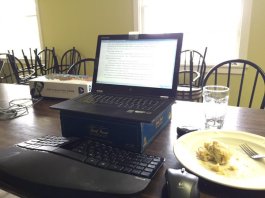
Let me just say that the Winter 2015 RandyCon was a rousing success. Songs were sung, jokes were told, and many thousands of words were written, or, in the case of the revisers, unwritten. I myself churned out almost 9000 words, which is around thirty-five pages for any non-writer-folk readers this blog post may attract. I killed off a character, introduced the Big Bad, wrecked the town and the magic school, and my protagonist did something unpredictable and that I didn’t like but that showed me a little more about who she is and what she’s capable of.

So yeah, I feel like it was pretty successful.

For those still scratching heads, RandyCon is a twice-yearly writers’ retreat put on by Randy Henderson (a hell of a writer and a hell of a nice guy, you should check out his books here) at Fort Worden State Park near Port Townsend, WA. It’s a decommissioned military base that used to house artillery for coastal defense that’s been repurposed as a rudimentary resort and office park, and RandyCon happens at (I’m guessing) an old NCO barracks. It’s a pretty good setup: big kitchen and common areas, and four wings of three or four small rooms each, with a bathroom in each wing. There were thirteen of us, all told (although there was some coming and going), and we all brought treats and provisions and took turns cooking and cleaning and so forth.

Daytimes are for writing Continue reading “RandyCon Writers’ Retreat Wrap-Up”

Cooking Your Food Without Burning the House Down, or Why Capitalism Is Like Fire

I think it’s clear to everyone that capitalism in the United States has gotten pretty out of control lately. Inequality is at or approaching Gilded Age levels. Job security no longer exists for most people. The middle class is vanishing, even though no one will admit it, most especially those who’ve slipped a rung or two on the economic ladder. Yet by the numbers the economy’s doing pretty well, and mostly recovered from the shock of the housing bubble popping. Which is true, if you’re a too-big-to-fail corporation or a member of the one percent.

For the rest of us, not so much.

It doesn’t have to be this way, and once upon a time not that long ago, it wasn’t. Say what you will about the three decades spanning the mid-forties to the mid-seventies; economically speaking it was kind of a Golden Age. Thanks to the safeguards put in place after the Great Depression (and some frankly redistributive top tax brackets), there were decades of consistent economic growth, the fruits of which were more widely shared than at any time or place in history. If you’re not old enough to remember, ask your parents or grandparents what it was like back in the day, when you could get a good-paying job right out of high school that could buy a house and support a family and came with lifetime security and a pension and a raise every year.

So, how did we get from there to where we are now? More importantly, how do we get to a better place, economically speaking, one where the incredible prosperity that capitalism can produce is more widely and fairly distributed? Because let’s face it, no other way of organizing economic activity human beings have ever tried has come even close to producing the plenty that properly regulated capitalism can.

There are lots of answers to the questions I’ve just posed, things to do with tax law and the regulation of banks and financial institutions. But the first thing, to my mind, is to reframe the way we think about capitalism. Thanks to a combination of the Cold War and the tenets of market fundamentalism and trickle-down economics, contemporary discussions of capitalism, at least in the United States, tend to be pretty reductive: you’re either fer it or agin’ it, with nary a shade of nuance in between. The success of this either-or narrative is a big reason we are where we’re at.

So how shall we reframe our thinking about capitalism? The most useful answer I’ve been able to come up with to that question is this: Continue reading “Cooking Your Food Without Burning the House Down, or Why Capitalism Is Like Fire”

One Man International Rescue Mission: After-Action Report, Part 1

I got the call last Monday. I missed it, actually, because I was taking a nap. I’d just finished Octavia Butler’s Fledgling, and as is not unusual after reading a work of that power, compellingness, and degree of writerly badassitude, I needed to shut down my conscious brain and let my psyche digest what I’d spent the last day and a half gorging on (to the detriment, obviously, of my list of action items). Not unusual, like I said, but there was a weird edge to the feeling: anxious, almost nauseous even. I don’t remember what I dreamed about, but I remember waking up unsettled and still groggy. I wonder if I didn’t have some premonition of what was coming (it wouldn’t be the first time something like that has happened to me).

I woke up, went to the bathroom, washed my hands. My brain still refused to gear up. Usually when I cat-nap, it takes me a couple of minutes to remember who/what/where I am, and at this point I was past the usual threshold, but not necessarily worryingly so. I saw the phone blinking, touched the screen, saw my dad had called and left a voicemail. I remember thinking, “I wasn’t expecting a call from Dad,” and again there was that tiny backbrain premonition.

I unlocked the phone, hit the voicemail icon, put the phone to my ear.

“Dallas, it’s your dad. Call me immediately-” I didn’t bother listening to the rest of the message. Continue reading “One Man International Rescue Mission: After-Action Report, Part 1”

Resolution and Resolve

So it’s New Year’s, that arbitrary yet persistently meaningful occasion when, after a few months of holiday excess, we take it upon ourselves to reflect on the year gone by, and to commit ourselves to improvement or at very least change in the year to come.

My list of particular resolutions is much the same as everyone else’s. Suffice to say it involves being healthier and more focused on what gives my life meaning, and setting aside habits that keep me from doing that as well as I could. I am resolved, in short, to be a better, more useful, more productive person than I have been.

In thinking on my New Year’s resolutions I got to thinking of the dual meaning of the word ‘resolution’ itself. This time of year, it means mostly a formalizing of resolve, a determination that things will change, become a certain way. But it also means fidelity in the rendering of a signal (think a high-resolution video screen), in which the higher the resolution, the clearer the picture that’s rendered. I think it’s useful to keep both definitions in mind when contemplating a mindful personal evolution.

Mindful personal evolution means changing who you are as a person in some meaningful way, which can be really, really hard to do. There’s great comfort in familiarity, and it’s the easiest thing in the world to fall into old habits rather than risk the uncertainty of doing something different. Without a clear vision of not only who you want to become but also why you aren’t already that person, the will to change alone will only get you so far. I’ll give you a personal example: Continue reading “Resolution and Resolve”

How’s the Writing Going?

I get this question a lot, and it’s a hard one to answer.  Usually I go with something innocuous, like “It’s going alright” or “It’s kicking my arse” or “I hate it with the passion of a million white-hot suns.”  Sometimes, if circumstance permits, I might go into a bit more detail, but I have to stop myself from opening the can up too wide, because I could literally talk for hours and most people don’t have time to hear, much less digest, the full report.  I’ll give you an example.

There’s a story I wrote last summer, about woodworking and a zombie apocalypse, among other things.  Call it Story X.  I worked on it for a few months, did some research, got it banged into what I thought was a pretty good shape, and went ahead and submitted it a couple of times, receiving (relatively) quick rejections.  I knew the beginning, vivid and prettily-worded though it was, wasn’t accomplishing enough, so I went over it again, basically rewriting what I’d written before in a way I hoped would be more compelling.  As I learned when I submitted it to my writers’ group (which is what I should have done in the first place), I was not particularly successful, and every one of my estimable colleagues saw through my prosaic hand-waving and called me out on it (for which I thank them).  At the time I’d started in on a novel, so I set Story X aside and tried not to think much about it.  A month or two later I took a hiatus from writing altogether, and have been slowly easing myself back into it for the last month or so.  Since I’m not quite ready to get back into novel mode I decided to bang my head against Story X for awhile and see which cracked first.

So far I’m slightly ahead.

Continue reading “How’s the Writing Going?”