
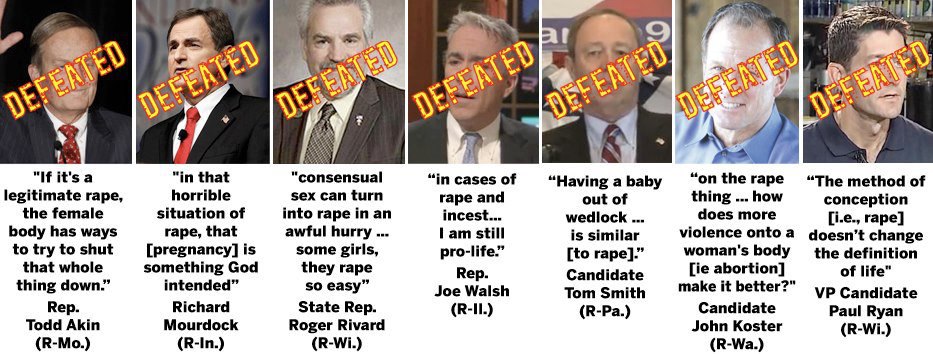
Did You Hear Them Roar?

“Message to the GOP: stop making women angry. You won’t like us when we’re angry.”

So said friend and fellow Clarionite Kali Wallace when I posted this picture on my facebook page, and I couldn’t agree more.

You don’t hear people talking about it much these days, but in the run-up to the 2010 election, in which the GOP took over the House of Representatives, the campaign was jobs, jobs, jobs.  But as soon as they were sworn in, the Tea Party insurgents and the remainder of the Republican establishment decided that they would be best served if the economy didn’t recover, and they turned their legislative efforts back to the Culture War, with a deeply misguided emphasis on women’s health and reproductive rights.

I think it’s fair to say that that decision came back to bite them squarely on the ass, as well it should have. Continue reading “Did You Hear Them Roar?”

Baby Steps, or, The Liberal Case for Voting Obama

I voted for Ralph Nader in 2000, even though I actually wanted Al Gore to win the election.

Why did I do that?  Because I wanted the Green party to qualify for federal matching funds in future presidential campaigns.  I kept track of the polls, and the morning of the election I saw that Al Gore was up four points in WA, so I felt like it was okay for me to vote strategically, and did so.  Had I still lived in Florida, land of my birth, there would never have been any question.

I’m a liberal, you see.  And while I am as idealistic as they come on most issues, I am also cursed with a pragmatic streak, which robs of me of the ability to take an all-or-nothing approach to the things that matter most.

It’s trite to say it, but elections matter. Continue reading “Baby Steps, or, The Liberal Case for Voting Obama”

Dallas Taylor's avatar[this space intentionally left blank]

It’s November 1st, All Saints’ Day and the anniversary of my mother’s funeral.  I originally wrote this about three weeks after the fact, and every year on this day I like to repost it, both to honor her memory, and because something happened that day that was truly, genuinely magical.  At least for me it was:

There’s much in this world that’s savage and horrifying, that will break your heart and confound your understanding and shake your faith in the justice and beauty and rightness of things. But there is also magic and wonder and days when the sun bursts through the clouds and suddenly the grey is silver and the silver becomes gold as the gathered clouds are scattered and flee beyond the horizon. Days when levity overcomes gravity’s ineluctable pull and loads are lightened for reasons the conscious mind isn’t really equipped to understand or make sense of.

View original post 1,707 more words

My Mother’s Funeral

It’s November 1st, All Saints’ Day and the anniversary of my mother’s funeral.  I originally wrote this about three weeks after the fact, and every year on this day I like to repost it, both to honor her memory, and because something happened that day that was truly, genuinely magical.  At least for me it was:

There’s much in this world that’s savage and horrifying, that will break your heart and confound your understanding and shake your faith in the justice and beauty and rightness of things. But there is also magic and wonder and days when the sun bursts through the clouds and suddenly the grey is silver and the silver becomes gold as the gathered clouds are scattered and flee beyond the horizon. Days when levity overcomes gravity’s ineluctable pull and loads are lightened for reasons the conscious mind isn’t really equipped to understand or make sense of.

I had such an experience recently, and I would like to tell you about it, if for no other reason than because it happened and I can’t tell you why, though it may very well have saved my spirit and soul from the muck they were mired in. It was, perhaps, just a coincidence, something that just happened. Something for which there is and was a perfectly logical, rational explanation, that I’m making more of than is really there to be made.

The possibility is very real that that is the case and that I’m just grasping at straws for my own (understandable) reasons. I’ll let you decide what to make of it for yourself. Here is what happened: Continue reading “My Mother’s Funeral”

The Zombie on the Mantelpiece

The New York Times has an interesting and erudite Op-Ed today by Amy Wilentz called A Zombie is a Slave Forever that explores the historical foundations of the zombie phenomenon along with some of the cultural resonance that adheres to their particular New World provenance and flavor.  It’s fascinating stuff, and makes some interesting observations.  But it fails, I think, to capture the essence of the current North American fascination with the walking dead.  An example:

There are many reasons the zombie, sprung from the colonial slave economy, is returning now to haunt us. Of course, the zombie is scary in a primordial way, but in a modern way, too. He’s the living dead, but he’s also the inanimate animated, the robot of industrial dystopias. He’s great for fascism: one recent zombie movie (and there have been many) was called “The Fourth Reich.” The zombie is devoid of consciousness and therefore unable to critique the system that has entrapped him. He’s labor without grievance. He works free and never goes on strike. You don’t have to feed him much. He’s a Foxconn worker in China; a maquiladora seamstress in Guatemala; a citizen of North Korea; he’s the man, surely in the throes of psychosis and under the thrall of extreme poverty, who, years ago, during an interview, told me he believed he had once been a zombie himself.

Given the circumstances of the zombie’s cultural and historical provenance, Wilentz’ article does a good job of unpacking the historical materialist aspects of the phenomenon, and her critique hints obliquely at what I think the roots of our current fascination with zombies are.  But cosplay and zombie walks aside, I don’t think the connection is what she thinks it is.  For one thing, I don’t think the American mainstream is culturally literate enough to draw the connection between the zombie and the ideal slave/factory-worker (hence the op-ed’s existence in the first place).  You don’t really see zombies being put to work in the movies and literature (at the end of Shaun of the Dead, a little, but rarely elsewhere).  They are, rather, a symptom of apocalypse, of total societal breakdown, and I think it’s there that we find the real seed-crystal of their current cultural resonance. Continue reading “The Zombie on the Mantelpiece”