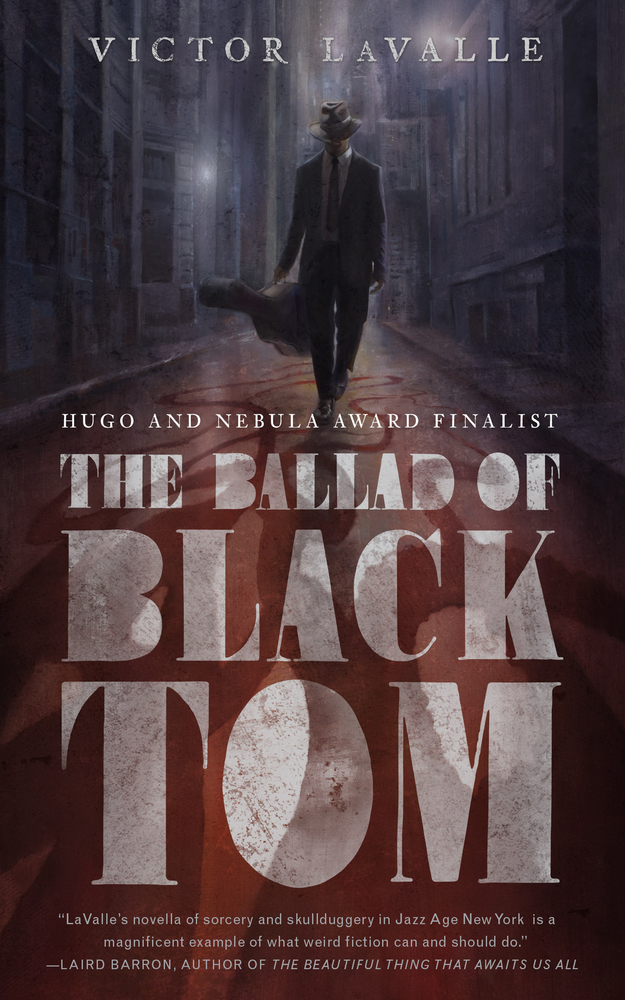
Black History Month Book Report #3: The Ballad of Black Tom, by Victor LaValle

So, unlike many if not most spec fic writers, I never had a Lovecraft phase. I mean, I knew the name. But if I read anything until much later in life, it didn’t stick. So I hadn’t read The Horror at Red Hook, of which The Ballad of Black Tom by Victor LaValle is a retelling from the point of view of a black man.

Not that it’s required to enjoy this page-turner of a dark mystery novella set in ’20s-era Harlem and New York. Which is good, because I’m about three decades past the point where Lovecraft’s turgid prose and particular brand of cosmic horror was going to land. Victor LaValle, I’ll be reading more of.

Tommy Tester is a hustler and musician living in Harlem with his father, who makes his living playing music for white people and doing the odd odd job for them, too. When Robert Suydam, a mysterious and wealthy white man with a very strange plan to liberate New York’s poor and marginalized, hires him to play a party in his mansion, it opens the door (alright, eldritch portal) to a whole new (horrific) world for Tommy. Continue reading “Black History Month Book Report #3: The Ballad of Black Tom, by Victor LaValle”

Black History Month Book Report #2: American Street by Ibi Zoboi

I wasn’t going to read this one second (though it was on the list). But then I cracked the cover and read the first chapter, and, just like that, I was hooked.

American Street begins with a loss. Fabiola Toussaint and her mother, Valerie, are moving to Detroit from Port-au-Prince. Fabiola is American born, and passes through immigration with no problem. But now she’s stuck on the wrong side of the glass: her mother has been detained. Reluctantly, she boards her connecting flight to Detroit, hoping against hope that her mother will follow along shortly.

I don’t think I’m spoiling much if I say that her mother does not. Instead, Fabiola (shortly Fabulous) joins her cousins Chantal, Princess (‘Pri’), and Primadonna (‘Donna’) and her aunt Jo in Detroit, where Fabiola must find a way to navigate this strange and dangerous territory while holding on to who she is and trying to find a way to bring her mother through the gateway and into America.

It’s a neat trick, establishing empathy with a character you’ve just met, and Zoboi does it flawlessly in those first pages and then never lets up. Fabiola must find her way through not only the culture shock of moving from Haiti to America, but also the discrepancies between the America she expected and the America she experiences, all while trying to build a sense of family with her cousins, who were only voices on the phone til she arrived, and restore the family she’s known her whole life by getting her mother through immigration. Add in the dangers of high school, the drug trade, and the particular precariousness of life in Detroit, fallen symbol of the 20th Century American Dream, it’s no wonder Fabulous feels lost. Luckily, she has her vodou practice, her cousins, and her memories to carry her through.

This is one of those books that just grabs hold of you and doesn’t let go. At least it was for me. Tautly-plotted and written in prose that manages to be visceral, poetic, and windowpane-clear all at once, I chewed my way through most of this book in a single day. I can see why it won the National Book Award.

Immigrant stories are an American perennial, both because of the long and mostly positive history of our lifted lamp beside the golden door, and because we can see it most clear through fresh eyes, both in its ideal form (both foreign and domestic) and its actuality. Here that actuality takes many forms: the injustice of splitting Fabiola from her mother, the Faustian bargain she’s offered by a local police detective, and the fruits of that bargain, too, which I won’t spoil but will have you nodding and saying ‘yeah, that’s about right’ even as you wipe a tear from your eye and read on, hoping Zoboi will take it back. But of course she doesn’t, because even though Fabiola is eminently root-forable, this is America, and she and her family – and everyone near their home at the corner of American Street and Joy Road – are black.

That’s not to say this book is a bummer. Much of it is so ebullient and alive that the reader will forgive the inescapably complicated state of things by the end. It is, perhaps, as happy an ending as can be asked for, and one that satisfies even if you don’t get all you root for.

Either way, this is a fantastic book, and one I’d recommend both for its all-too-relevant subject matter and its stunning fulfillment of the promise it makes in those first few pages. Go ahead, pick it up. I’m willing to bet you won’t put it down.

9/11/18

I was gonna write a whole thing about 9/11, but my memories are no specialer than anyone else’s – and less special by far than many. Besides, look around. We haven’t learned a goddam thing. Bin Laden succeeded beyond his wildest dreams.

So, instead, here is a sentence that is also a haiku:

Kids born after the
towers fell can now fight the
war we’re not losing.

John McCain’s Death

So… John McCain. Were there things to like about him? Sure. Did he have some good moments? Undoubtedly. There’s the one everyone’s sharing, where he told an old woman to her face that Barack Obama was a decent person and not a foreign-born Muslim spy/interloper/Manchurian candidate. Which, if you think about it, should not have been a high bar to clear. But given the turn toward wackadoodlism the GOP had taken and continues to take, I suppose that counts as political courage. Even if his thrusting of the unvetted, wholly unqualified half-term governor of Alaska into the national spotlight took that emergent wackadoodlism the rest of the way to cloudcuckooland, leading, among other things, to the cyberwar being waged on us by the Russians (remember Jade Helm? How Texans convinced themselves it was actually the US military invading them, to put them in concentration camps built from old Wal-Marts? And Greg Abbott sent the Texas state guard to ‘monitor’ the situation? That’s when the Russians knew they could cause us serious damage without firing a shot, just by feeding the credulous disinformation that fit their confirmation bias).

Of course, he never did meet a war he didn’t like (‘Bomb bomb bomb, bomb bomb Iran’). Or a tax cut he wouldn’t vote for. Truth be told, he was as reliable a conservative as anyone.

And, let’s not forget that, when the chips were down and the soul of America was on the line in the torture debate, the man who knew how not only evil but ineffective it was folded in the face of political headwinds. The man with the most moral authority on the subject – a man who might have saved us going down that slippery slope – opted to sponsor a toothless bill that exempted the CIA (hello, Gina Haspel, current director) from sticking to the Army Field Guide’s non-torturous techniques for interrogation. Which made the whole thing a distraction at best.

That he remained as popular as he did – and does, even among those who disagree with him – and that he still garners the respect that he does is a testament to John McCain’s real legacy, his greatest accomplishment by far, in which he was, I think, unparalleled: the man knew how to build, and maintain, a brand.

I mean, seriously. He was a torture survivor who signed off on officially-sanctioned torture, who voted with hardline conservatives ninety percent of the time, a man who lent his credibility to Sarah Palin and cleared the ground for the rise of Tea Party conservatism and the worst instincts of the American right. But we still call him a straight-talking maverick who always stuck by his principles and his sense of right and wrong.

Say what you will about the man. But that’s one hell of an accomplishment. Too bad it didn’t do anyone but him any good.

Fuck Depression

Depression is a thing that will fuck you up, no matter how well things are or seem to be going. It saps the foundations like termites, wears away self-esteem like your own personal, internalized gaslighter. It’s kicked my ass up, down, left, right, sideways, and diagonally, and I am a person routinely mistaken for strong. Depression is a cancer, a colonizer of the soul, dimmer of the spark and whisperer of bitterest nothings in your psyche’s ear. It wears you away, eats you away from the inside.

It is also, in some times and some cases, a perfectly rational and reasonable response to the world we live in, which seems to conspire to create misery for most so a few can accrue — if not always enjoy — prosperity and power and wealth.

So yes, be kind, because you never know what kind of struggle someone’s going through, and kindness costs nothing but pays the highest possible dividends. But as we mourn another dead celebrity, another had-it-all suicide, another loved one or friend or friend of a friend, let’s not just be kind.

Let’s resolve to build a world that makes people happy. That takes care of their needs and provides space and opportunity for them to flourish. That asks what they can give and gives more than they would ask. That takes the prosperity and progress we as a species have achieved — and can achieve — and sees to it everyone gets their share, and that no one gets left behind. No one falls through the cracks.

Let’s build a world that takes care of everybody, that lets everyone live their best, most productive, and happiest possible life, so we don’t have to lose these bright shining stars before their time anymore, and because, goddamit, it’s the right fucking thing to do.