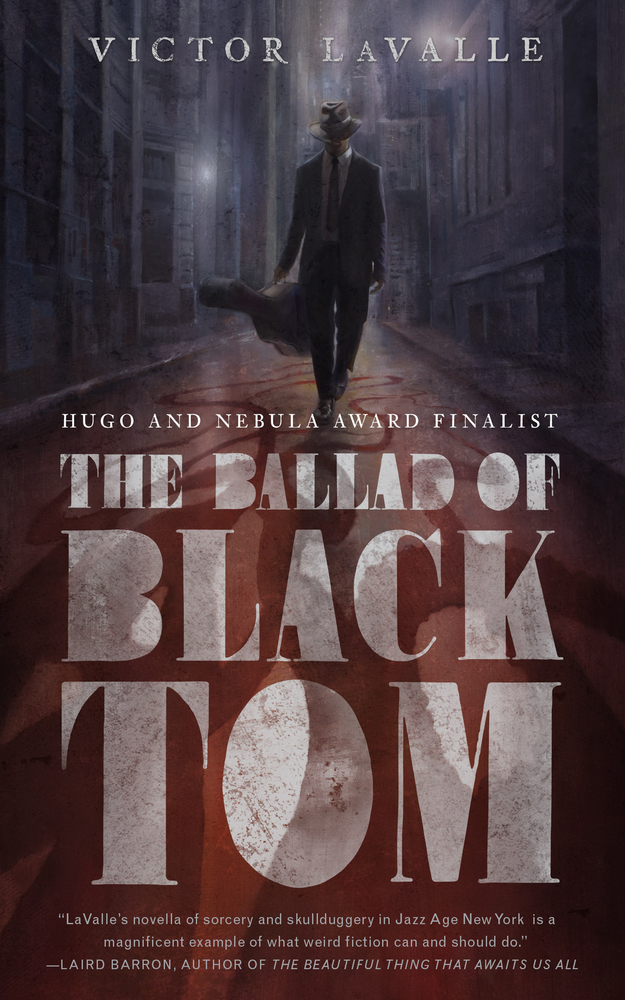
Black History Month Book Report #3: The Ballad of Black Tom, by Victor LaValle

So, unlike many if not most spec fic writers, I never had a Lovecraft phase. I mean, I knew the name. But if I read anything until much later in life, it didn’t stick. So I hadn’t read The Horror at Red Hook, of which The Ballad of Black Tom by Victor LaValle is a retelling from the point of view of a black man.

Not that it’s required to enjoy this page-turner of a dark mystery novella set in ’20s-era Harlem and New York. Which is good, because I’m about three decades past the point where Lovecraft’s turgid prose and particular brand of cosmic horror was going to land. Victor LaValle, I’ll be reading more of.

Tommy Tester is a hustler and musician living in Harlem with his father, who makes his living playing music for white people and doing the odd odd job for them, too. When Robert Suydam, a mysterious and wealthy white man with a very strange plan to liberate New York’s poor and marginalized, hires him to play a party in his mansion, it opens the door (alright, eldritch portal) to a whole new (horrific) world for Tommy. Continue reading “Black History Month Book Report #3: The Ballad of Black Tom, by Victor LaValle”

Black History Month Book Report #2: American Street by Ibi Zoboi

I wasn’t going to read this one second (though it was on the list). But then I cracked the cover and read the first chapter, and, just like that, I was hooked.

American Street begins with a loss. Fabiola Toussaint and her mother, Valerie, are moving to Detroit from Port-au-Prince. Fabiola is American born, and passes through immigration with no problem. But now she’s stuck on the wrong side of the glass: her mother has been detained. Reluctantly, she boards her connecting flight to Detroit, hoping against hope that her mother will follow along shortly.

I don’t think I’m spoiling much if I say that her mother does not. Instead, Fabiola (shortly Fabulous) joins her cousins Chantal, Princess (‘Pri’), and Primadonna (‘Donna’) and her aunt Jo in Detroit, where Fabiola must find a way to navigate this strange and dangerous territory while holding on to who she is and trying to find a way to bring her mother through the gateway and into America.

It’s a neat trick, establishing empathy with a character you’ve just met, and Zoboi does it flawlessly in those first pages and then never lets up. Fabiola must find her way through not only the culture shock of moving from Haiti to America, but also the discrepancies between the America she expected and the America she experiences, all while trying to build a sense of family with her cousins, who were only voices on the phone til she arrived, and restore the family she’s known her whole life by getting her mother through immigration. Add in the dangers of high school, the drug trade, and the particular precariousness of life in Detroit, fallen symbol of the 20th Century American Dream, it’s no wonder Fabulous feels lost. Luckily, she has her vodou practice, her cousins, and her memories to carry her through.

This is one of those books that just grabs hold of you and doesn’t let go. At least it was for me. Tautly-plotted and written in prose that manages to be visceral, poetic, and windowpane-clear all at once, I chewed my way through most of this book in a single day. I can see why it won the National Book Award.

Immigrant stories are an American perennial, both because of the long and mostly positive history of our lifted lamp beside the golden door, and because we can see it most clear through fresh eyes, both in its ideal form (both foreign and domestic) and its actuality. Here that actuality takes many forms: the injustice of splitting Fabiola from her mother, the Faustian bargain she’s offered by a local police detective, and the fruits of that bargain, too, which I won’t spoil but will have you nodding and saying ‘yeah, that’s about right’ even as you wipe a tear from your eye and read on, hoping Zoboi will take it back. But of course she doesn’t, because even though Fabiola is eminently root-forable, this is America, and she and her family – and everyone near their home at the corner of American Street and Joy Road – are black.

That’s not to say this book is a bummer. Much of it is so ebullient and alive that the reader will forgive the inescapably complicated state of things by the end. It is, perhaps, as happy an ending as can be asked for, and one that satisfies even if you don’t get all you root for.

Either way, this is a fantastic book, and one I’d recommend both for its all-too-relevant subject matter and its stunning fulfillment of the promise it makes in those first few pages. Go ahead, pick it up. I’m willing to bet you won’t put it down.

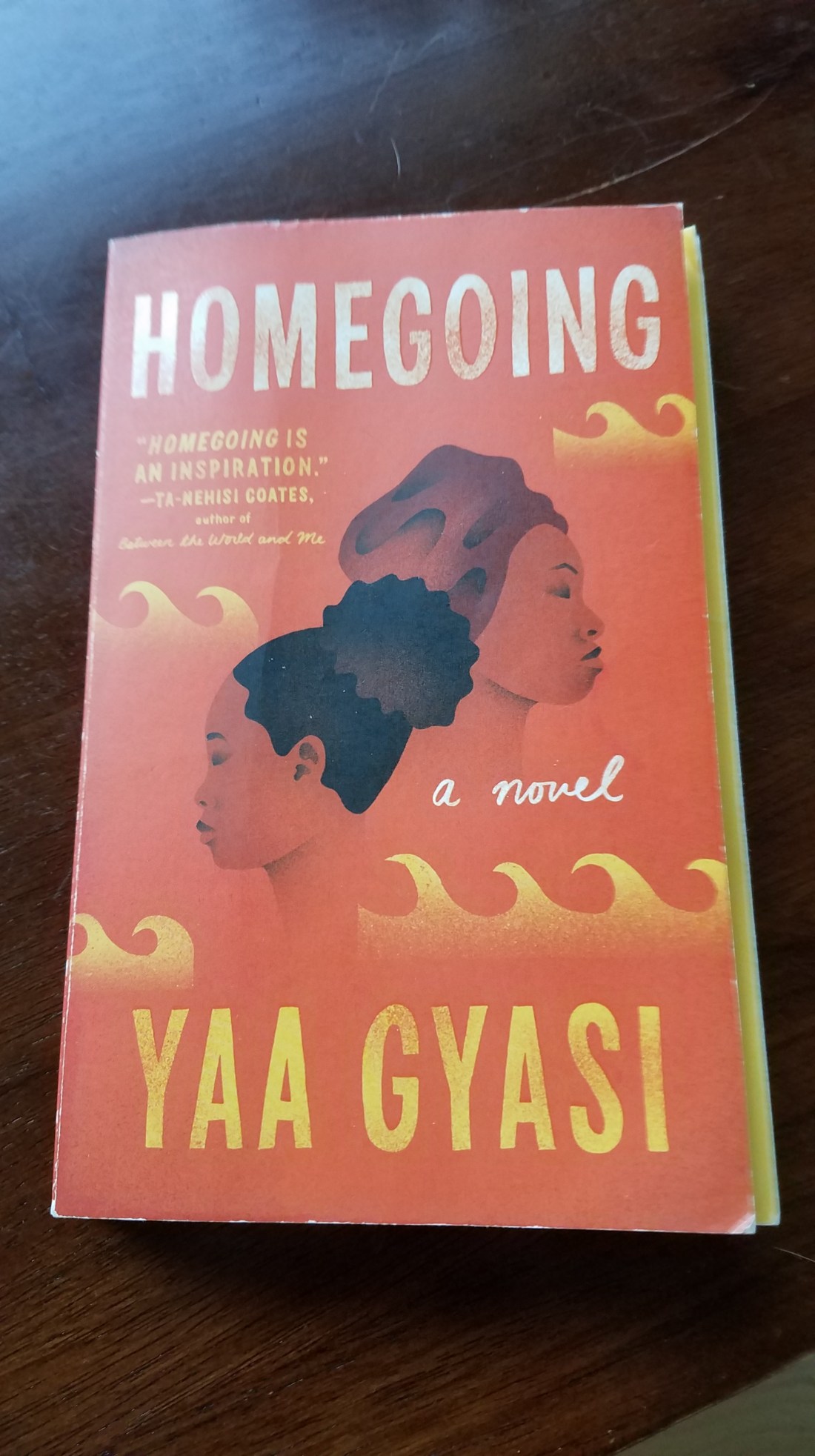
Black History Month Book Report #1: Homegoing, by Yaa Gyasi

First off, this is a great book that succeeds on just about every level. If good books is your jam, here is one.

A woman escapes slavery in the Gold Coast in the late 18th Century. She leaves behind one daughter, goes inland to freedom, has another. One daughter marries an Englishman, and lives out her life in a castle by the ocean. The other is captured, and taken there as a slave, to be sold on to the American South. The novel follows their children and grandchildren down the generations, alternating between the lines, as they live their lives embedded in our history, both African and American, until more or less the present day.

It’s a worthy conceit to hang the novel’s structure on, though not without its dangers. Characters rarely appear in more than two or three successive chapters, and each chapter has a new protagonist moving through a significant chunk of their lives. Each has their arc, though thanks to the history we’re following, arcs do not so much as close as find a way to keep going under immense and unfair restrictions. In less deft hands, a novel like this might fail to resonate, but Gyasi does such a good job with her characters that most all of the chapters are satisfying, to the reader if not the protagonist, and when characters reappear in their children’s lives we can see what those children can’t, that their parents were people in their own right, trapped in unkind history, and doing what best they could under the circumstances, even if that best wasn’t great.

Gyasi’s gorgeous, evocative prose helps the project along immensely. She has a knack for framing that conveys a rich, deep world in the background, the kind of world you could wander off and get lost in if you weren’t careful. But you never do, because the narrative carries you forward, through decades and centuries of lived history, of heartbreak and small victories just great enough to keep it all going, all of it rendered with flawless grace and economy.

My intent is to keep things spoiler-free, so I won’t go into individual characters and arcs. Telling truth, I think it best to encounter them with fresh eyes, even if you know your history well. What Homegoing excels at is melding that history with story, with the stories of lives lived swimming in history’s currents in the wake of the African slave trade. It is, all of it, complicated, with sympathetic villains and humanizing moments to spare, and Gyasi doesn’t spare the reader that complexity in the service of easy answers. This is a work of art, not polemic, after all.

I’m disinclined toward numerical rating, or trying to give my subjective experience a gloss of objectivity. Suffice to say, if you are a person who enjoys moving, beautifully written, well-constructed literature (with or without a capital ‘L’), you will find Homegoing to be all that and more. If you have the interest (and fortitude) to take a long and often painful look at the ramifications of human chattel slavery, in a well-researched  and -rendered (albeit fictional) form, you could do a lot worse than read Homegoing.

It’s one thing to know something intellectually, say that Jim Crow laws in the post-Civil War South led to all manner of abuses. It’s another to engage with a firsthand account, or a first-rate artistic engagement, one that plays to the full human spectrum, rather than seek emotionless shelter in facts. To my mind, it’s one of the highest purposes of human creative endeavor, an accomplishment of serious magnitude when well-executed. Yaa Gyasi has done that, and then some, with Homegoing.

You should read it.

When Someone Is Wrong on the Internet

I mean, you’re never going to change that asshole’s mind. Why bother engaging? Why roll the rock all the way to the top of the hill when you know it’s just going to roll right back down once you reach the top? You’d do better to conserve your passion and energy for something useful, like calling your Congressional representatives or digging a shelter to cache supplies for the coming post-Apocalyptic nightmare that will surely follow the decline and fall of the American Experiment.

And look, there probably are a hundred better things you can do with your time. And probably you should do them. I mean, we’re all going to die someday, which means our time is finite. Probably best we spend it doing positive things.

But you know what? There are some damn fine reasons to engage the shitheads, trolls, and wingnuts of the internet-o-sphere if you have the time, emotional bandwidth, and outrage to spare. So, in the spirit of, like, five years ago, let’s make a list, shall we? Continue reading “When Someone Is Wrong on the Internet”

Toxic Masculinity vs Depression

I knew something was wrong the moment my mom walked into my room. It wasn’t just that she was crying, though she was. In a moment I was crying, too, because it was my mom waking me up to go to school that morning. Which was not her job. My dad was the one who woke me up for school in the morning. The moment I laid eyes on my mom I knew: my dad finally left her.

I was in fifth grade. Not quite ten years old. It was the early ’80s, and I was very shortly to have the disctinction of being the first kid I knew whose parents got a divorce.

It wasn’t a surprise. Like I said, I knew right away what had happened. And to be honest, I can’t — and could not at the time — remember a time when my parents weren’t fighting. I didn’t know what they were fighting about, didn’t really even want to. It was just a thing that happened, and when it did I would go to my room and play with my toys or read a book or I’d go outside and ride my bike around the neighborhood or go knock on a friend’s door or one of the thousand other things kids did back in the days when parents weren’t expected to schedule and supervise their childrens’ entire existence.

That morning was the last time I cried about it.

Because like I knew what had happened the night before, I knew what was expected of me. What was expected of any boy who wasn’t girly or gay or soft or weak. No one had to tell me that boys don’t cry.

So I didn’t. I tamped that shit down, put on my game face, and went on a field trip to Sea World with the rest of my class. As I recall, my dad was one of our chaperones. I didn’t ask him what happened. I mean, it wasn’t like it was a surprise. The real surprise was it hadn’t happened sooner.

I remember being very proud of myself for being so mature.

It wasn’t long after that I started acting out. Continue reading “Toxic Masculinity vs Depression”