The Limits of Argument

Man, do I love a good argument. Seriously, ask anyone who’s known me at any point in the last forty years and they’ll tell you. It’s like my brain’s factory wiring was optimized for it. It’s such a rush, when I’ve got a really good one going with a smart, well-informed person whose positions and beliefs are different from my own. It does for my brain what playing soccer does for my body.

I’ve spent decades doing it, in all kinds of situations, with all manner of people. It’s honed my critical faculties and made me question the assumptions at the foundation of my worldview. I’ve learned many valuable lessons as a result.

The most valuable lesson I learned? If you actually want to change or even open someone’s mind, arguing almost never works.

Here’s something that’s happened to me more times than I can count. Maybe it’s happened to you, too. You get into it with somebody. Things get heated. You’re going back and forth, back and forth, and you realize you’re both making the same argument in different words. And if you’re like me, it’s kind of frustrating, because you’re all het up and there’s nothing to argue about anymore.

After the nth time that happened, I started to realize that, at least for me, the contentiousness was the pay-off. The heated back and forth. A chance to let my rage nugget vent a little steam so it doesn’t boil over some inappropriate time. Like when I play soccer.

And I’ve come to think of argument in the same way as soccer. For me, at least, it’s best approached as a sport, a competition I engage in with fellow enthusiasts whom I cultivate online and IRL, who approach it with the same understanding. It won’t surprise you that most of them are lawyers and academics.

But if I want to get through to someone, and actually change the way they see the world (or at least get them to take a look at how I see it), getting all het up and marshalling facts and arguments and statistics and memes isn’t how I go about it anymore.

Nobody, but nobody, likes being told they’re wrong, and they like it even less if you can prove it.

In my experience, if you want to change someone’s mind, the best you can do is plant a seed and hope it takes root. And to do that, you have to find common ground to plant it in. It’s surprisingly easy to do if you start from a position of respect. If you frame what you have to say in such a way that it’s taken for granted that the person or people you’re dealing with have reasons for their views that they find genuinely convincing and good. If you ask them to explain, make the positive case, nine times out of ten you’ll find something in there you can both agree on.

Once you’ve established a rapport by genuinely engaging, and built goodwill by finding some point of agreement, you can show them the way to where you’re at from where you’re both standing. Connect the dots, make the positive case. Let them decide for themselves.

Will it work? Sometimes. And almost never right away. That’s why I use planting a seed as a metaphor. If you want a plant to grow or an idea to take hold, you have to find that common ground, and prepare it. Then you can plant the seed and, if conditions are favorable, the seed will sprout. It will grow roots, and when enough time has passed it will break ground into the light, and grow organically on its own.

Changing people’s minds is a really hard thing to do. But even if you just open them up a little bit more, that’s a good thing. A net gain for the ideas and ideals that you’re passionate about. And in my experience it’s a hell of a lot more effective at spreading them than browbeating people til they submit or defriend you out of exasperation.

Arguing and debating is a really fun sport, with the right people. But when the chips are down and the stakes are real, I think I owe what I believe in its best possible chance of spreading and taking root. Because the more of us there are, the better the chances of making it happen. Which I think will be good for everybody.

Even the people who disagree with me.
RandyCon Writers’ Retreat Wrap-Up

CDdIQqnVIAA244K
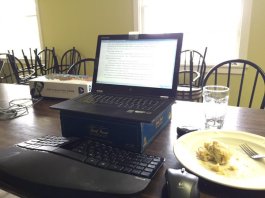
Should have taken more pictures.

Let me just say that the Winter 2015 RandyCon was a rousing success. Songs were sung, jokes were told, and many thousands of words were written, or, in the case of the revisers, unwritten. I myself churned out almost 9000 words, which is around thirty-five pages for any non-writer-folk readers this blog post may attract. I killed off a character, introduced the Big Bad, wrecked the town and the magic school, and my protagonist did something unpredictable and that I didn’t like but that showed me a little more about who she is and what she’s capable of.

So yeah, I feel like it was pretty successful.

For those still scratching heads, RandyCon is a twice-yearly writers’ retreat put on by Randy Henderson (a hell of a writer and a hell of a nice guy, you should check out his books here) at Fort Worden State Park near Port Townsend, WA. It’s a decommissioned military base that used to house artillery for coastal defense that’s been repurposed as a rudimentary resort and office park, and RandyCon happens at (I’m guessing) an old NCO barracks. It’s a pretty good setup: big kitchen and common areas, and four wings of three or four small rooms each, with a bathroom in each wing. There were thirteen of us, all told (although there was some coming and going), and we all brought treats and provisions and took turns cooking and cleaning and so forth.

Daytimes are for writing Continue reading “RandyCon Writers’ Retreat Wrap-Up”

I Read Only Books by Women For a Year: Here’s What Happened

I read a lot of great books, is the short answer.

So, a few days ago writer K Tempest Bradford published this article, in which she challenged readers to stop reading white, straight, cisgendered male authors for one year. Sadly (and predictably), certain corners of the internet exploded in rage at the notion (she has assembled a lovely collection of rage-tweets here, if you enjoy that sort of thing). I won’t reprise their objections, which savvy interneteers will likely be able to intuit themselves, nor pass judgement on any validity those objections may or may not have. But it so happens that I recently spent the better part of a year doing something very similar to Ms Bradford’s challenge. From roughly November 2013 until late last year, I read only books by women(*), many of them women of color, others not cisgendered (two of the new favorite writers whose work I discovered are married).

I did so for my own reasons, both personal and (for lack of a better term) professional. On a personal level it was simply the realization that the vast majority of the books on my overstuffed shelves were by men. I fought it for a long time, that realization. I mean, these were great books, each easily defensible on the merits. I have, if I may say, damned fine taste in literature, and reading material in general. Ask any of my friends. I’ve been an obsessive reader since kindergarten, the kind of person who never goes anywhere without a book and hasn’t since he could carry one. But looked at en masse, the unconscious bias in my collection was (and is) painfully clear (in my defense, I actually am a cisgendered white male).

My bookshelves.
My bookshelves.

When I was younger, the notion of placing any kind of limitation on my reading material for a whole year would have seemed preposterous. Now comfortably ensconced in middle age, it didn’t seem like that big a deal. It wasn’t like I was going to run out of good books to read, and while it might mean holding off on some things in my to-be-read stack, it’s hardly without precedent for a book to be in that stack for years before I get around to reading it. Really all I had to do was rearrange the order, though of course I used it as an excuse to go book-shopping, which is one of my favorite things to do.

The timing that November seemed propitious. I’d started writing Continue reading “I Read Only Books by Women For a Year: Here’s What Happened”

Things I Learned on the Internet This Week 8/8/14

Another week gone, and the internet (and the world it reflects, or possibly refracts) continues to fascinate. So, in my continuing efforts to excuse to myself the embarrassing amount of time I spend surfing the internet, here is a selection of highlights from my procrastinations this week:

Warren Layre, 61, told The Inquirer in an interview last year that the officers beat him with a steel bar and kicked in his teeth during a warrantless raid on his machine shop on West Sedgwick Street in June 2011. Speaking to a reporter two years later, he pulled back his lip to show the gaps in his teeth that remained.

According to Wednesday’s indictment, Liciardello reported less than $7,000 of the $41,158 they seized from Layre’s shop.

Truth really is stranger than fiction, as this story of six corrupt cops up on racketeering charges in Philadelphia attests. For ten years, these guys ran rampant through the city, shaking people down and sending people to jail on trumped-up charges and basically running a standover operation, and the only thing that stopped them was that one of them finally got caught and turned stool pigeon. If this was on TV, it’d be a huge hit, and I expect some day it will be. In fact, I think these guys are a natural extension of the portrayal of law enforcement in our entertainment culture, which I think has a lot of similarities to what happened (and continues to happen) between Hollywood and the Mafia.

Moving on to American law enforcement at the institutional level, we learn from the Washington Post that

Nearly every criminal case reviewed by the FBI and the Justice Department as part of a massive investigation started in 2012 of problems at the FBI lab has included flawed forensic testimony from the agency, government officials said.

For years, even decades, a team in the FBI crime lab misrepresented its results in order to secure convictions. Not unlike the situation in Philadelphia, the problem was known but institutional inertia prevented it from being attended to until outed by investigative reporter Spencer Hsu.

The review comes after The Washington Post reported in April that Justice Department officials had known for years that flawed forensic work might have led to the convictions of potentially innocent people but had not performed a thorough review of the cases. In addition, prosecutors did not notify defendants or their attorneys even in many cases they knew were troubled.

Worst of all, innocent people may have been executed. The first article in the series sums it all up pretty well, I think.

Officials started reviewing the cases in the 1990s after reports that sloppy work by examiners at the FBI lab was producing unreliable forensic evidence in court trials. Instead of releasing those findings, they made them available only to the prosecutors in the affected cases, according to documents and interviews with dozens of officials.

In addition, the Justice Department reviewed only a limited number of cases and focused on the work of one scientist at the FBI lab, despite warnings that problems were far more widespread and could affect potentially thousands of cases in federal, state and local courts.

As a result, hundreds of defendants nationwide remain in prison or on parole for crimes that might merit exoneration, a retrial or a retesting of evidence using DNA because FBI hair and fiber experts may have misidentified them as suspects.

And, just in case you weren’t yet fully convinced of the dysfunction in US law enforcement culture, here’s one more slug to the guts.

“I felt so vulnerable being laid out on a table, with all my clothes off and in a bag and all the swabs and brushes and combs,” she recalled. But at least, she figured, the police would use the swabs and hair samples to help catch the rapist.

They did not. Like hundreds of thousands of other rape kits across the country containing evidence gathered from victims, that of Ms. Ybos lay untested for years on a storeroom shelf.

(hat tip to Charles P. Pierce, one of my favorite writers, period, for this post, where I found most of the above)

Having gotten through all that, I think we could all use a break. Here’s a picture of the sunset at Second Beach, where I went camping with my girl and just the loveliest bunch of people you could ever want to hang out with last weekend. Continue reading “Things I Learned on the Internet This Week 8/8/14”

A Glimpse Into This Writer’s Life

It’s been a pretty exciting week for this semi-pro writer. Yesterday came an email from the submissions editor of a well-respected speculative fiction market (one I’ve been trying to break into for years) saying she was passing my current submission up to the editor-in-chief. It’s further than I’ve ever gotten with this market, so even if the EIC passes, I’ve still got that going for me, which is nice.

Today I finally queried another market, who’s had a story of mine for just over a year and a half (not unusual for them, for what it’s worth), to see if my story was still under consideration. I’ve been putting this off for a long time, afraid I might trigger a rejection or, worse, that the silence would continue. But they got right back to me and said yes, the story is still under consideration. Which is cool, and totally freaks me out, because I definitely feel like I’m punching above my weight class with this one.

Currently only have one other sub out, which I don’t expect to hear back from for at least another month. Given the timeframe, it’s one of those situations where the longer it takes to hear back from them, the better.

I’ve got two more stories that are almost ready for submission, one a novelette I wrote a couple of months ago that I’m nearly done tinkering with, the other a story I wrote two years ago in South America, revised, sent to most of the usual suspects, market-wise, and then thought of a way better ending for. If I can get one or both of those ready and out the door, I’ll feel pretty good about my number of active submissions.  Continue reading “A Glimpse Into This Writer’s Life”