Another Example of Why Elizabeth Warren is My Jam

One good thing about Iowa’s lack of expected results is it lets us see how the candidates react to the unexpected, sort of a Rorschach test of their character, if you will. I’m not gonna comment on other campaigns: judge them as you will. But this, this is what I want from my next President, and I submit that maybe you ought to, too:

Seriously, what’s not to love?


Some Quick Reminders for the Iowa Conspiracy Theorists

First and foremost: There’s a paper trail — for the first time, btw, so put that in your pipe and (retrospectively) smoke it — so the results will come in, and probably be reasonably accurate. That they will be muddled because of how many ways the totals are gonna be split, and because — for some reason — they are reporting not one, not two, but three metrics by which a winner might be declared would have been the case even if things went smooth like butter.

Second, and I can’t stress this enough: Iowa doesn’t really matter! The state accounts for a whopping 1% of convention delegates, which is how the party decides who gets the nomination. In fact, the first four states (IA, NH, NV, and SC) only account for about 5% of delegates (the latter two were moved up to help counterbalance the, ahem, whiteness of the traditional first two). The media likes to pretend they matter more than they actually do, because it gives them fodder to create narratives (and winnow the field). But really, we’re not going to have a good idea who’s ahead, behind, or viable going forward til Super Tuesday, when about half the delegates will be allotted in one big day of primary voting.

Third: Of course the app went wrong. It’s a brand new piece of bespoke tech — developed for a complex, idiosyncratic process — that couldn’t be field-tested beforehand because how would you even do that? Add to that that rules were changed in the way the caucuses work (because this ain’t the first time they’ve had problems calling a winner the night or even the week of), and remember that the vast majority of poll workers are retiree volunteers who don’t know a whole lot about the cyber, and the likeliest — even inevitable — outcome is what happened.

Fourth, and really more of an aside: The changes that are fucking this all up were implemented after complaints from Sanders supporters in 2016, who wanted a more transparent process with a paper trail and yadda yadda yadda (instead of, you know, getting rid of these arcane, uninclusive, undemocratic rituals in favor of the simplicity of a primary vote). That these selfsame people — and the bots who love them — are making the biggest stink about what’s going down is both extremely on-brand and perfectly in tune with the tragilarious irony that has characterized this blighted timeline since the Large Hadron Collider was turned on and everyone lost their goddam minds.

Fifth: While the various conspiracies — Russian/Republican ratfucking, DNC scale-tipping against Bernie/Joe/Pete/whoevs — are not unplausible, I urge you recall Hanlon’s Razor, which says, simply:
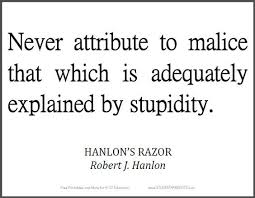
Unknown-1

So, deep breaths, everybody. Relax. For once, we’ve woken up the day after Iowa without a handy narrative to shape perceptions about the race going forward. The voting’s just started, the race is still tight. Which, you know, accurately reflects the reality.

This is a good thing.

One Good Thing About the Iowa Democratic Caucus Snafu

440px-Private_SNAFUIt’s a tossup, right now, whether tonight’s app-related debacle for the Iowa Democratic party is the result of ratfucking — be it Republican or Russian — or just standard issue Democratic rake-stepping, or even just the semi-inevitable buggery when a new tech gizmo is deployed for the first time. Either way it’s giving all of us agita while we wait for the paper/pics of paper to be tallied. The whole thing is pretty on-brand for the twenty-first century.

But there is one silver lining, which is in every explainer published instead of the vote totals (or whatever) and what it all means analysis they all expected to go with, everyone’s finally admitting that Iowa doesn’t mean shit, delegate-wise, and is only important because the caucuses, simply by being first, help shape perceptions and narrative.

Yet the power of the caucuses is that they can change that state of play. Based on Iowa’s results, candidates believed to be in the top tier can either solidify that status or stumble, and underdogs can either break out or fall flat. Iowa has this effect because it greatly influences the perceptions of the political world — the media, activists, party insiders, donors, the candidates themselves, and voters — about who can win.”

And that, my friends, is a righteous good thing.

All of punditry has been waiting for this night, when they can finally say who’s up or who’s down, who’s a contender, who beat or missed expectations, who should throw in the towel. Every four years, a few hundred thousand white people performing an arcane ritual that has people sorting themselves into physical groups and then performing arcane calculations to allocate delegates who will themselves meet later to perform calculations to allocate delegates, who will themselves blah blah blah so that, come June, 40-odd of 4000-odd delegates to the Democratic Convention can yell their candidate’s name. It’s a ridiculous, outdated process (I, myself, have attended two caucuses, which were such complete shit-shows that I ended up running both precincts because, well, someone had to), a relic from a bygone era of not picking candidates by popular vote. Which is not a good look for a party that takes its name from the word ‘democracy’.

Look, I got nothing against Iowans. But they aren’t even remotely representative of the people who make up/vote for the Democratic party. They’ve had a good thing going these last fifty years, what with the quadrennial boost to their economy. But a tiny, empty, rural state performing an outdated political ritual to allocate their near-inconsequential number of delegates isn’t much better than strange women in ponds distributing swords when it comes to picking a candidate for President.

It’s not like that’s a big secret. But it’s nice to see it said out in the open like that.


Mother Jones CoFounder Richard Parker on Why He Supports Elizabeth Warren

From the Nation:

“In my view, Warren offers a far more plausible and more detailed case for how the next president must run the government once in office. Her “I’ve got a plan for that” is actually true: She and her staff tapped first-class teams of advisers from nationwide networks of progressive lawyers, economists, techies, educators, medical and military personnel, and environmentalists. In each of her plans, she has adroitly analyzed key issues (in readable, nontechnical language) and stated what her administration would do to address them.

[…]

“In her skill and dedication campaigning for other candidates; in doggedly shepherding tough, controversial bills through Congress; and in constructing a significant federal agency from scratch, Warren has demonstrated her ability to both win elections and govern.

Just as important, in weaving together support across the Democrats’ diverse constituencies, she has shown herself to embody not just the prophetic but also the complex and very human mix of emotions most of us feel: indignation, empathy, hope, openness—the deep, abiding yearning to turn America in a new direction.”

https://www.thenation.com/article/warren-president-endorsement-2020/

Baldwin on King and X

James Baldwin may have been America’s clearest-eyed thinker, and was certainly one of its best writers. His work, The Shot That Echoes Still, from (and reprinted/reposted by) Esquire in 1972 deserves to be revisited more than ever, be it almost fifty years later, for its commentary on the times it was written in, and for its prescience. It is, above most everything else, the moral failure Baldwin diagnosed, here and elsewhere, at the heart of the American psyche that has given us the age of Trump and Trumpism, and the rot at the heart of American whiteness that made them not only possible but inevitable:

“Incontestably, alas, most people are not, in action, worth very much; and yet every human being is an unprecedented miracle. One tries to treat them as the miracles they are, while trying to protect oneself against the disasters they’ve become. This is not very different from the act of faith demanded by all those marches and petitions while Martin was still alive. One could scarcely be deluded by Americans anymore, one scarcely dared expect anything from the great, vast, blank generality; and yet one was compelled to demand of Americans—and for their sakes, after all—a generosity, a clarity, and a nobility which they did not dream of demanding of themselves. Part of the error was irreducible, in that the marchers and petitioners were forced to suppose the existence of an entity which, when the chips were down, could not be located—i.e., there are no American people yet. Perhaps, however, the moral of the story (and the hope of the world) lies in what one demands, not of others, but of oneself. However that may be, the failure and the betrayal are in the record book forever, and sum up and condemn, forever, those descendants of a barbarous Europe who arbitrarily and arrogantly reserve the right to call themselves Americans.

[…]

I don’t think that any black person can speak of Malcolm and Martin without wishing that they were here. It is not possible for me to speak of them without a sense of loss and grief and rage; and with the sense, furthermore, of having been forced to undergo an unforgivable indignity, both personal and vast. Our children need them, which is, indeed, the reason that they are not here: and now we, the blacks, must make certain that our children never forget them. For the American republic has always done everything in its power to destroy our children’s heroes, with the clear (and sometimes clearly stated) intention of destroying our children’s hope. This endeavor has doomed the American nation: mark my words.

Malcolm and Martin, beginning at what seemed to be very different points—for brevity’s sake, we can say North and South, though, for Malcolm, South was south of the Canadian border—and espousing, or representing, very different philosophies, found that their common situation (south of the border!) so thoroughly devastated what had seemed to be mutually exclusive points of view that, by the time each met his death there was practically no difference between them. Before either had had time to think their new positions through, or, indeed, to do more than articulate them, they were murdered. Of the two, Malcolm moved swiftest (and was dead soonest), but the fates of both men were radically altered (I would say, frankly, sealed) the moment they attempted to release the black American struggle from the domestic context and relate it to the struggles of the poor and the nonwhite all over the world.

To hold this view, it is not necessary to see C. I. A. infiltrators in, or under, every black or dissenting bed: one need merely consider what the successful promulgation of this point of view would mean for American authority in the world. Slaveholders do not allow their slaves to compare notes: American slavery, until this hour, prevents any meaningful dialogue between the poor white and the black, in order to prevent the poor white from recognizing that he, too, is a slave. The contempt with which American leaders treat American blacks is very obvious; what is not so obvious is that they treat the bulk of the American people with the very same contempt. But it will be sub-zero weather in a very distant August when the American people find the guts to recognize this fact. They will recognize it only when they have exhausted every conceivable means of avoiding it.

[…]

What both Martin and Malcolm began to see was that the nature of the American hoax had to be revealed—not only to save black people but in order to change the world in which everyone, after all, has a right to live. One may say that the articulation of this necessity was the Word’s first necessary step on its journey toward being made flesh.”