Some Quick Reminders for the Iowa Conspiracy Theorists

First and foremost: There’s a paper trail — for the first time, btw, so put that in your pipe and (retrospectively) smoke it — so the results will come in, and probably be reasonably accurate. That they will be muddled because of how many ways the totals are gonna be split, and because — for some reason — they are reporting not one, not two, but three metrics by which a winner might be declared would have been the case even if things went smooth like butter.

Second, and I can’t stress this enough: Iowa doesn’t really matter! The state accounts for a whopping 1% of convention delegates, which is how the party decides who gets the nomination. In fact, the first four states (IA, NH, NV, and SC) only account for about 5% of delegates (the latter two were moved up to help counterbalance the, ahem, whiteness of the traditional first two). The media likes to pretend they matter more than they actually do, because it gives them fodder to create narratives (and winnow the field). But really, we’re not going to have a good idea who’s ahead, behind, or viable going forward til Super Tuesday, when about half the delegates will be allotted in one big day of primary voting.

Third: Of course the app went wrong. It’s a brand new piece of bespoke tech — developed for a complex, idiosyncratic process — that couldn’t be field-tested beforehand because how would you even do that? Add to that that rules were changed in the way the caucuses work (because this ain’t the first time they’ve had problems calling a winner the night or even the week of), and remember that the vast majority of poll workers are retiree volunteers who don’t know a whole lot about the cyber, and the likeliest — even inevitable — outcome is what happened.

Fourth, and really more of an aside: The changes that are fucking this all up were implemented after complaints from Sanders supporters in 2016, who wanted a more transparent process with a paper trail and yadda yadda yadda (instead of, you know, getting rid of these arcane, uninclusive, undemocratic rituals in favor of the simplicity of a primary vote). That these selfsame people — and the bots who love them — are making the biggest stink about what’s going down is both extremely on-brand and perfectly in tune with the tragilarious irony that has characterized this blighted timeline since the Large Hadron Collider was turned on and everyone lost their goddam minds.

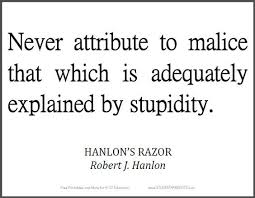
Fifth: While the various conspiracies — Russian/Republican ratfucking, DNC scale-tipping against Bernie/Joe/Pete/whoevs — are not unplausible, I urge you recall Hanlon’s Razor, which says, simply:

Unknown-1

So, deep breaths, everybody. Relax. For once, we’ve woken up the day after Iowa without a handy narrative to shape perceptions about the race going forward. The voting’s just started, the race is still tight. Which, you know, accurately reflects the reality.

This is a good thing.

One Good Thing About the Iowa Democratic Caucus Snafu

440px-Private_SNAFUIt’s a tossup, right now, whether tonight’s app-related debacle for the Iowa Democratic party is the result of ratfucking — be it Republican or Russian — or just standard issue Democratic rake-stepping, or even just the semi-inevitable buggery when a new tech gizmo is deployed for the first time. Either way it’s giving all of us agita while we wait for the paper/pics of paper to be tallied. The whole thing is pretty on-brand for the twenty-first century.

But there is one silver lining, which is in every explainer published instead of the vote totals (or whatever) and what it all means analysis they all expected to go with, everyone’s finally admitting that Iowa doesn’t mean shit, delegate-wise, and is only important because the caucuses, simply by being first, help shape perceptions and narrative.

Yet the power of the caucuses is that they can change that state of play. Based on Iowa’s results, candidates believed to be in the top tier can either solidify that status or stumble, and underdogs can either break out or fall flat. Iowa has this effect because it greatly influences the perceptions of the political world — the media, activists, party insiders, donors, the candidates themselves, and voters — about who can win.”

And that, my friends, is a righteous good thing.

All of punditry has been waiting for this night, when they can finally say who’s up or who’s down, who’s a contender, who beat or missed expectations, who should throw in the towel. Every four years, a few hundred thousand white people performing an arcane ritual that has people sorting themselves into physical groups and then performing arcane calculations to allocate delegates who will themselves meet later to perform calculations to allocate delegates, who will themselves blah blah blah so that, come June, 40-odd of 4000-odd delegates to the Democratic Convention can yell their candidate’s name. It’s a ridiculous, outdated process (I, myself, have attended two caucuses, which were such complete shit-shows that I ended up running both precincts because, well, someone had to), a relic from a bygone era of not picking candidates by popular vote. Which is not a good look for a party that takes its name from the word ‘democracy’.

Look, I got nothing against Iowans. But they aren’t even remotely representative of the people who make up/vote for the Democratic party. They’ve had a good thing going these last fifty years, what with the quadrennial boost to their economy. But a tiny, empty, rural state performing an outdated political ritual to allocate their near-inconsequential number of delegates isn’t much better than strange women in ponds distributing swords when it comes to picking a candidate for President.

It’s not like that’s a big secret. But it’s nice to see it said out in the open like that.


Terrell Jermaine Starr on the Iowa Caucuses’ Role in Privileging Whiteness

In the wake of the DNC (“Stepping on our own dicks since 1972!”) changing debate qualifications so Mike Bloomberg gets his moment to shine after almost all the candidates of color have dropped/been forced out — and in these first days of Black History Month — this piece at The Root by Terrell Jermaine Starr resonates even more:

“Basically, Iowa allows white men to shoot their shot when they really shouldn’t even think about trying.

But it does something else far worse: kill the campaigns of non-white candidates. Sens. Kamala Harris and Cory Booker were two of the most resume-ready candidates for president in recent memory and their melanin was icing on the cake. However, neither of them were able to sustain their candidacies, which depended on prioritizing the black voters who were supposed to buoy their campaigns. Julián Castro, a Latino and former Housing and Urban Development secretary who championed racial justice more than any other person on the trail, dropped out in December.

[…]

One has to wonder if any of these candidates would still be in the race if, say, South Carolina, Georgia and Mississippi were the first primary states, where conversations around reproductive rights, infant mortality rates and combating racism would be at the top of black voters’ minds. Invariably, candidates would have to center black issues in the early stages of their campaigns and national media would have to shape coverage around these issues because it’s simply too many negroes in those states not to.

[…]

‘Iowa is considered ‘real America’ by far too many journalists and politicians where heartland, Middle America and rural are all proxies for whiteness and centering white political priorities,” Greer said. “And then New Hampshire just one week later presents a lopsided account of the needs, wants, and values of the entire party.’”

https://www.theroot.com/iowa-becky-the-hawkeye-state-is-gentrifying-black-peop-1841387214

Mother Jones CoFounder Richard Parker on Why He Supports Elizabeth Warren

From the Nation:

“In my view, Warren offers a far more plausible and more detailed case for how the next president must run the government once in office. Her “I’ve got a plan for that” is actually true: She and her staff tapped first-class teams of advisers from nationwide networks of progressive lawyers, economists, techies, educators, medical and military personnel, and environmentalists. In each of her plans, she has adroitly analyzed key issues (in readable, nontechnical language) and stated what her administration would do to address them.

[…]

“In her skill and dedication campaigning for other candidates; in doggedly shepherding tough, controversial bills through Congress; and in constructing a significant federal agency from scratch, Warren has demonstrated her ability to both win elections and govern.

Just as important, in weaving together support across the Democrats’ diverse constituencies, she has shown herself to embody not just the prophetic but also the complex and very human mix of emotions most of us feel: indignation, empathy, hope, openness—the deep, abiding yearning to turn America in a new direction.”

https://www.thenation.com/article/warren-president-endorsement-2020/

Brittney Cooper is Right: Warren’s Gender Matters

This Time article is worth quoting at length:

“But as we watch – and I with growing dread – the winnowing down of the Democratic field potentially to three white men, Sanders, Biden and Buttigieg, we are faced again with the problem of gender. I have, thus far, been disappointed watching progressive white feminists and feminists of color alike continue to argue for a socialist revolution on the grounds that gender would be covered. They make this same case about race, and that, too, is dubious.

Sanders is the most progressive and revolutionary candidate on the merits, these folks argue, so the fact that Warren is a woman – and similarly progressive – can’t matter. The insistence that an elderly white man’s socialist revolution will better address my 21st-century black feminist gender concerns is textbook white liberal paternalism. How will Sanders white masculinity affect and inform how he governs? This is a question that we should get to ask. Being progressive doesn’t mean that one’s race or gender ceases to matter in one’s leadership style and prerogatives, especially not in a world where gender and race are always presumed to matter for how women and people of color will govern.

[…]

There are two other broad strands of argument on the left from those who insist that they aren’t compelled to proffer the vagina vote. There are those on the black left, who have convinced themselves that there’s no reason to vote for a white woman, because white women are simply water-carriers for a white-supremacist project. As a black feminist, I stand in a long tradition of black women thinkers who have critiqued white women’s gender and racial politics and have called them out for their collusion with white supremacy. And as a regular black chick, I have more than a few stories of white women who inspire my resentment. But a patriarchal analysis reminds us that gender still matters, and it still determines access to structural leadership. In a world where white women voters skewed toward Trump and will likely skew toward him again, it’s fine to distrust white women. It’s not fine to shunt gender to the side when an actual progressive female candidate is running for office.

The second group judges candidates based on how they stack up on the merits with regard to progressive policy. So if you are a member of the radical anti-capitalist left, and Warren insists, as she did in Tuesday’s debate, in talking about how “to make markets work,” then on the merits you have to vote for Sanders the Socialist. Or so the argument goes. But because the analysis of gender here is ancillary, these folks never have to think about whether the first woman to win the presidency can do so as a socialist, given the ways that the concept of the “bleeding heart liberal” carries underneath it a misogynist edge about namby-pamby femme people. It is remarkable that Warren has fared as well as she has running as far to the left as she has. America carries big-stick energy around the world, a phallic project that places female leaders in the position of trying to replicate these behaviors in order to appear tough or reject them at the risk of appearing soft. (Hillary Clinton couldn’t crack this code, and Warren will have to figure it out if she manages to face Trump in the general.)

These voters also choose never to think about the ways that merit-based arguments of the same sort are deployed by corporate America or the halls of academia to wall women and racial minorities out of access to great jobs and organizational leadership opportunities. Anyone who has ever served on a committee charged with hiring candidates who bring some diversity to a place understands how things go when the white guy who meets all the criteria (because he has had structural access to all the privileges that would help him meet all the criteria) is up against a promising woman or person of color who is very good but falls down in a few categories. Or conversely she’s the best, but the standards as written and understood make hiring her seem like too much of a risk. Hiring committees often struggle with what feels to them like the fundamental unfairness of allowing a candidate’s diversity to put them over the top. Many (white) members of these committees see this as a sullying of (a mythic) meritocracy in a way that disadvantages white men. But first, they have to believe that the man in question received all his qualifications on the merits and not because of structural privileges. I expect people on the progressive and radical left, those who claim to understand how intersectionality works, to know better, but they aren’t acting like they do.

[…]

Wanting a woman to rise to the top of an almost all-male pack is not a position that needs defending. What should be defended is the uncritical desire to elect yet another man to a position that 45 men and zero women have held. That choice, to choose another man for President, should be held up to the strictest scrutiny and the highest standard. Gender alone is not a sufficient qualification to be President (though I can think of a few recent Presidents for which this seems to be the only qualification they had). But I am convinced that it should offer an edge in a situation where no cisgender women, trans people or gender nonbinary people have ever had a position. I think race should work similarly. The experiences one gains from being marginalized because of racism and sexism offer invaluable perspectives that often make candidates inclined to be more egalitarian and inclusive, precisely because they know intimately what exclusion feels like. We have another opportunity in this election to make clear that gender is not the stepchild of radical politics, and it is long past time that we take it.”


https://time.com/5765888/elizabeth-warren-gender-2020-election/